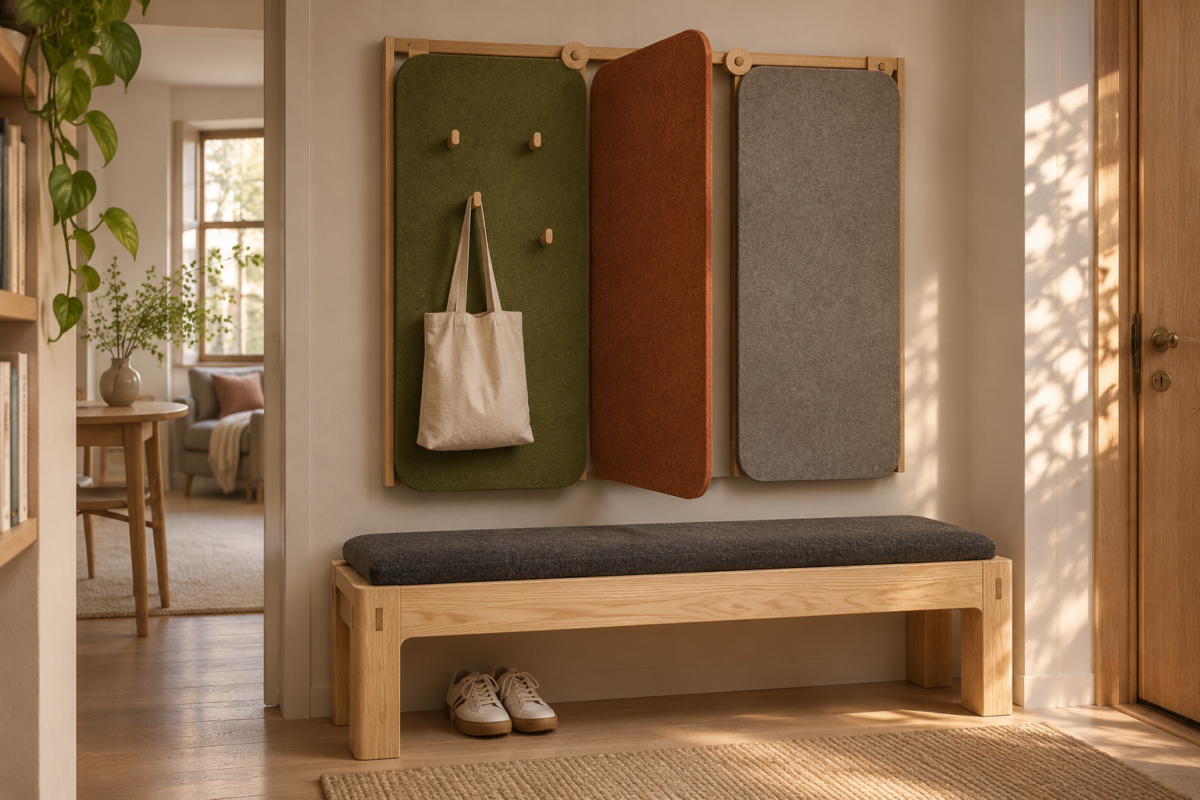
You come home with a tote sliding off your shoulder and a set of keys you can feel but somehow can’t grab. The moment you step inside, you nudge a green felt panel above the shoe bench. It turns like the page of a giant book. On the other side, there’s a hook for the tote and a little pocket for the keys. Your hands are free before you’ve even taken off your shoes.
Later that evening, you flip the panel back to its plain felt face. Beside it, you turn a rust-colored panel to reveal the things you need tomorrow. There’s a library book in a shallow sleeve and a note you’d otherwise leave on the kitchen counter.
This is an imagined furniture concept. Think of it as an entryway bench with a wall of pages you can turn to suit the moment.
What belongs on each side of the page?
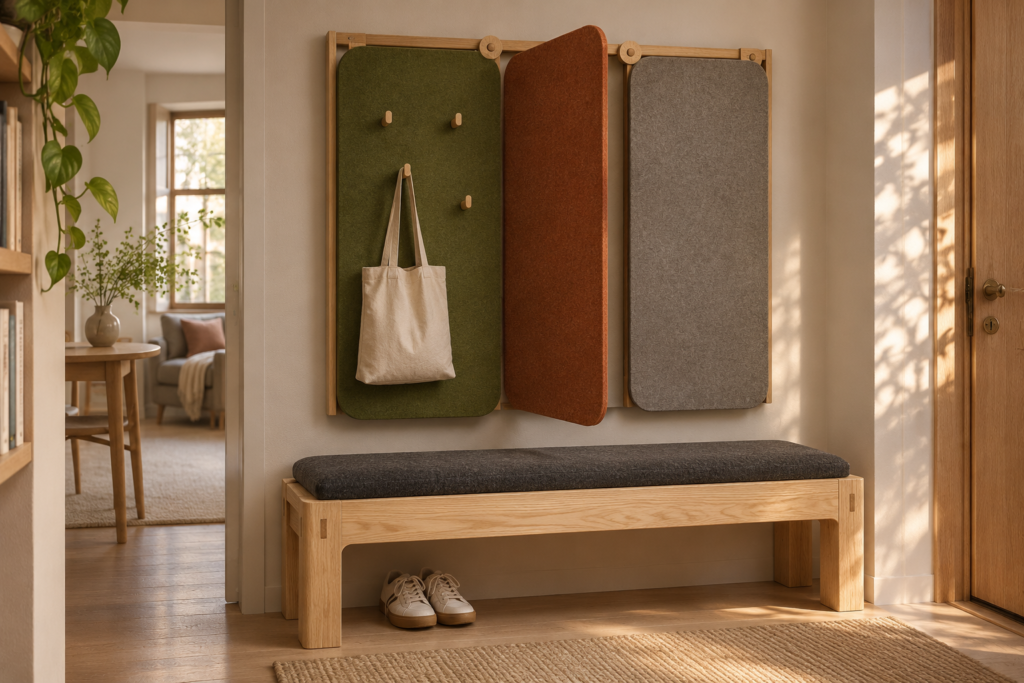
Picture a simple ash bench with an open space for shoes underneath. Above it, a shallow wall-mounted frame holds three slim panels, each turning on its own vertical pivot. One face is plain felt. The other holds a few lightweight items using shallow hooks, fabric sleeves, or soft pockets. Each panel turns independently, so you can leave tomorrow’s book in view while putting today’s keys away.
The most interesting panel might be the one in the middle. Give it a single pocket and use it for anything that needs to leave the house soon. A birthday card to mail. A permission slip to hand back. A receipt for a return. If the pocket is empty, turn it to its plain side. If the pocket is showing, there’s something to take with you.
That tiny change in the wall would be a reminder you can see while tying your shoes. And unlike a basket full of mail, it would give the library book a fighting chance of getting back to the library.
The hardest part is making room for the turn
From a furniture retailer’s point of view, the first question is whether the piece works in the space someone actually has. In a small entryway, the bench has to share its footprint with the front door, the person sitting down, and whoever is trying to walk past with the groceries.
The panel would need enough room behind it for a loaded pocket or a soft tote strap to clear the wall. The pivot would also need firm stops so a panel can settle flat in either position and won’t swing freely when someone brushes past. I’d put a recessed grip on the edge so you could turn it with one hand. Before settling on the dimensions, I’d mock up a panel in cardboard and check its full sweep with the door open and someone seated on the bench.
I’d also keep the shoe storage open and the bench seat uninterrupted. At the end of a long day, you should still be able to sit down and pull off your shoes without turning a single page.
Give the hallway a place for tomorrow
You can try the simplest part of this idea with a tray and one thing you need to take out of the house tomorrow. Put the tray on a surface you can see from the spot where you put on your shoes. Tonight, place that one thing in it. Leave your keys wherever you normally keep them so the tray has a clear purpose.
In the morning, see when you notice it. If you spot it while reaching for your shoes, you’ve found a good location. If you see it only as you’re closing the door, move it into your line of sight a step earlier. Try that for a few days before adding another tray, hook, or basket.
What would you put on the first page of your entryway?