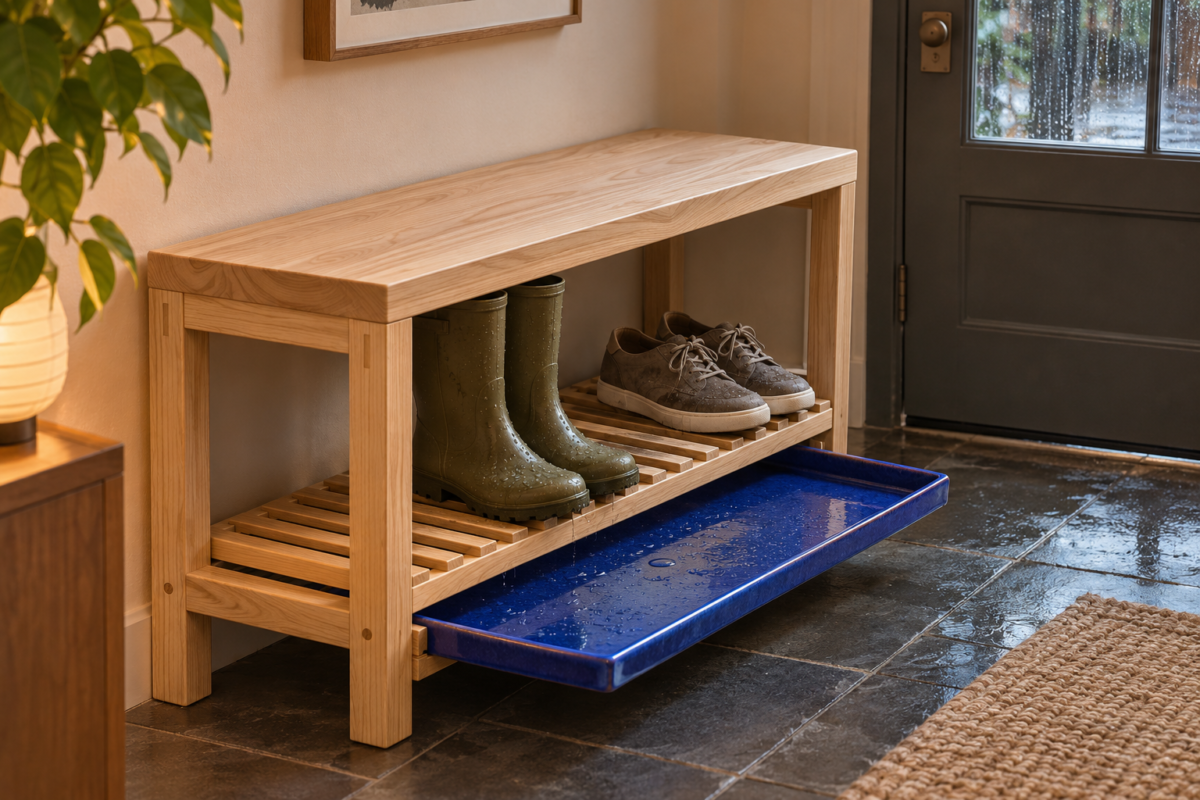
By the time you get the front door shut, one boot has already left a dark print on the floor. You sit down to pull off the other, hook a finger under the heel, and hear a small, bright tick. A drop has landed in a cobalt-blue tray tucked beneath the bench. Then another. The rain has followed you inside, but for once it has somewhere to go.
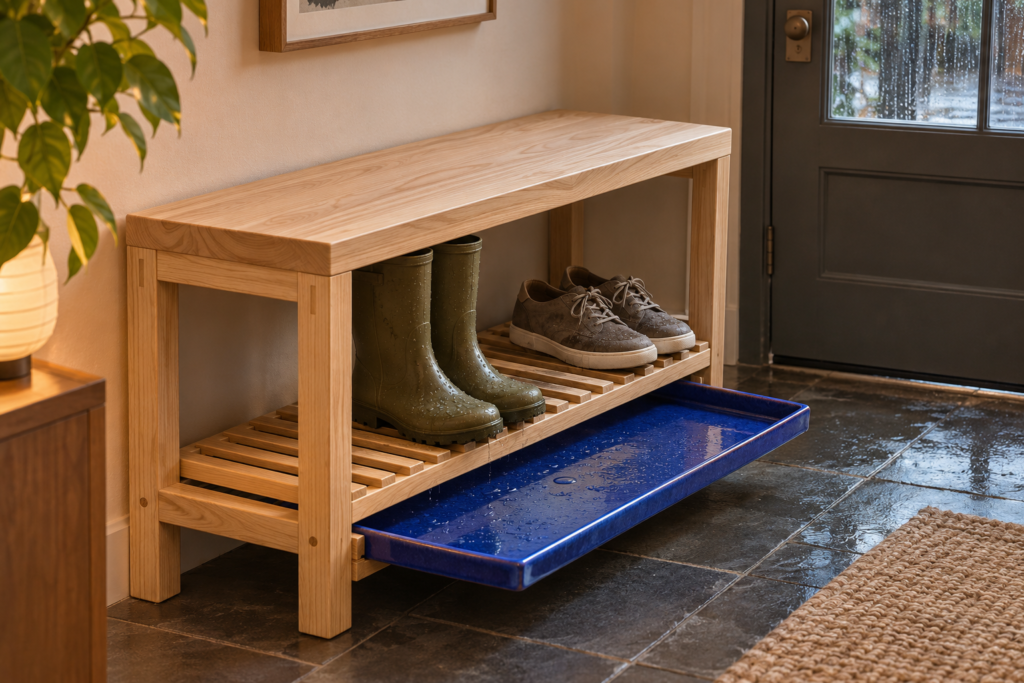
That’s the idea behind the Rain Catcher, a speculative entryway bench with a slatted shoe shelf and a pull-out drip tray. The seat gives you somewhere to take off your boots. The shelf gives them somewhere to stay. And underneath, a shallow ceramic tray catches what they bring home.
A little gutter under your boots
Picture a pale ash bench with an open shelf beneath the seat. You set your boots on the slats, and water drips through the gaps into a glazed ceramic tray. The tray would sit under the full shoe area, so a pair of boots parked heel-first or toe-first would still have something beneath it to catch the drips. A low rim would hold the runoff until you could empty it.
I’d give the tray a wide, rounded front lip you could grip with both hands. It would slide out on a simple support with a stop, so a quick tug wouldn’t send the whole thing into your lap. Once it reached the stop, you’d lift it free and carry it level to the sink. The cobalt glaze would give the bench a flash of color even when the tray was tucked away. Pull it out and the blue would come into view all at once, like opening a drawer and finding a piece of the sky.
The slatted shelf should lift out for cleaning, too. Otherwise, a bench that catches rain would also give road grit a permanent home in the corners. I’d want to be able to take the two parts to the sink separately and wipe the space underneath with an ordinary cloth.
The fit test happens with the door open
From my years in furniture retail, I bring a simple question to a design like this. What happens around the piece when someone actually uses it? A narrow bench can look like an easy fit on paper. At home, there’s also the front door swinging inward, a person sitting with their knees forward, and somebody else trying to get past with groceries.
The Rain Catcher would have to earn its place on three counts. The seat needs enough depth to sit on while tugging off a stubborn boot. The shelf needs enough height for the tallest pair you actually wear. And there has to be space in front of the bench to pull the tray all the way out and lift it without tipping it. In a tight hallway, that last measurement could decide which wall gets the bench.
Ceramic would be the detail I’d most want to see in a prototype. It gives the design its color and that little sound when water lands. It also raises a practical question. Could you comfortably lift the tray one-handed when it’s empty and carry it steadily with both hands when it’s wet? I’d test a shorter tray first. A long tray that takes a balancing act to empty would lose its charm by the second storm.
Try a rainy-day rehearsal
On the next wet day, put a shallow, rimmed boot tray you already have beside a sturdy seat, outside the door’s swing and clear of your walking path. Use the setup the way you normally come home. Sit down, take off your shoes, and see whether you can put both feet straight onto the tray without standing up or reaching across the doorway. Later, pick the tray up and take it to the sink. Notice how much room you need to lift it level.
That small rehearsal will tell you where a shoe bench belongs and how much space to leave in front of it. It may also reveal something simpler. If the easiest place to take off your boots is two steps from where you’ve been storing them, those two steps are probably where the wet footprints begin.