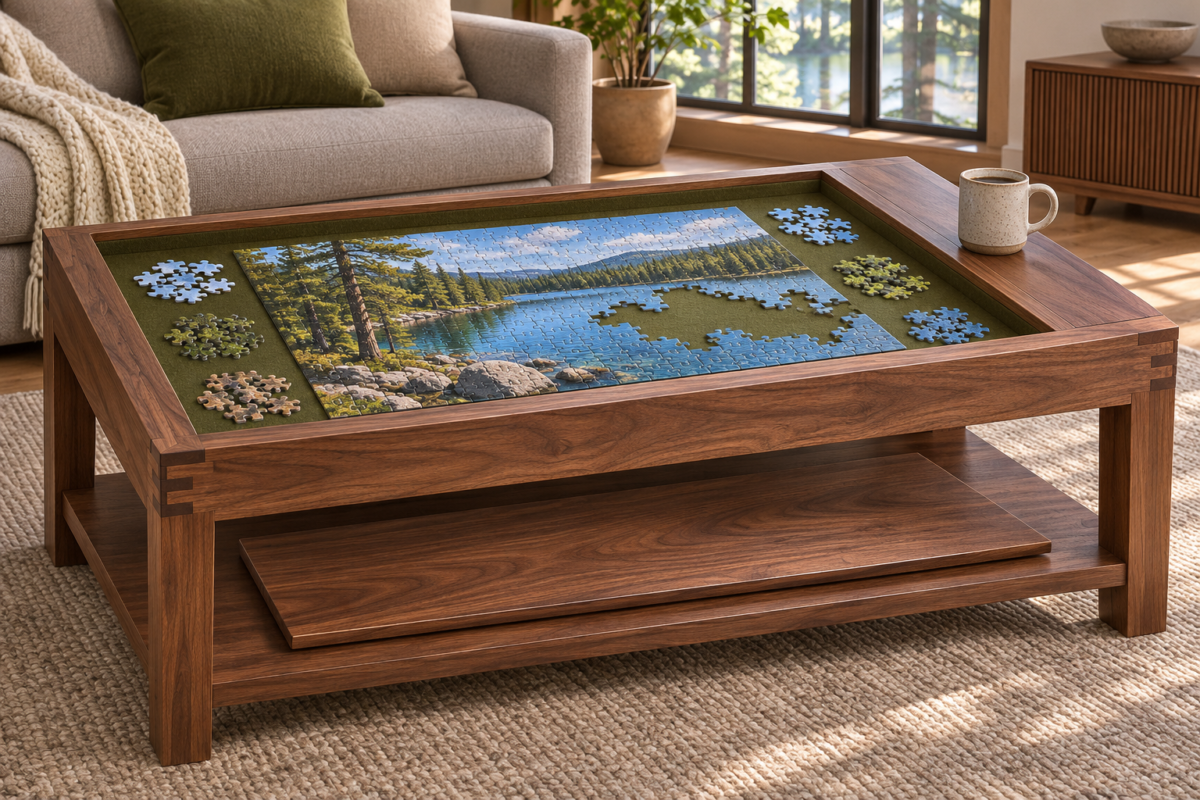
The doorbell rings just as you find the piece that joins the lake to the sky. You press it into place, look at the coffee table, and realize there’s nowhere to set a mug. The blue pieces are sorted on one side, the trees on the other, and a week’s worth of evenings sits between them. Your guest is already on the porch.
Imagine reaching down to the shelf, lifting out a walnut panel, and setting it over the puzzle. The panel rests on the table frame, a little above the tallest piece. You set down two mugs. When your guest leaves, you lift the panel away, and the lake is exactly where you left it.
That’s the idea behind this coffee table design concept. It gives an unfinished puzzle its own shallow workspace beneath an everyday tabletop, so a living room can change jobs without making you pack up what you were doing.
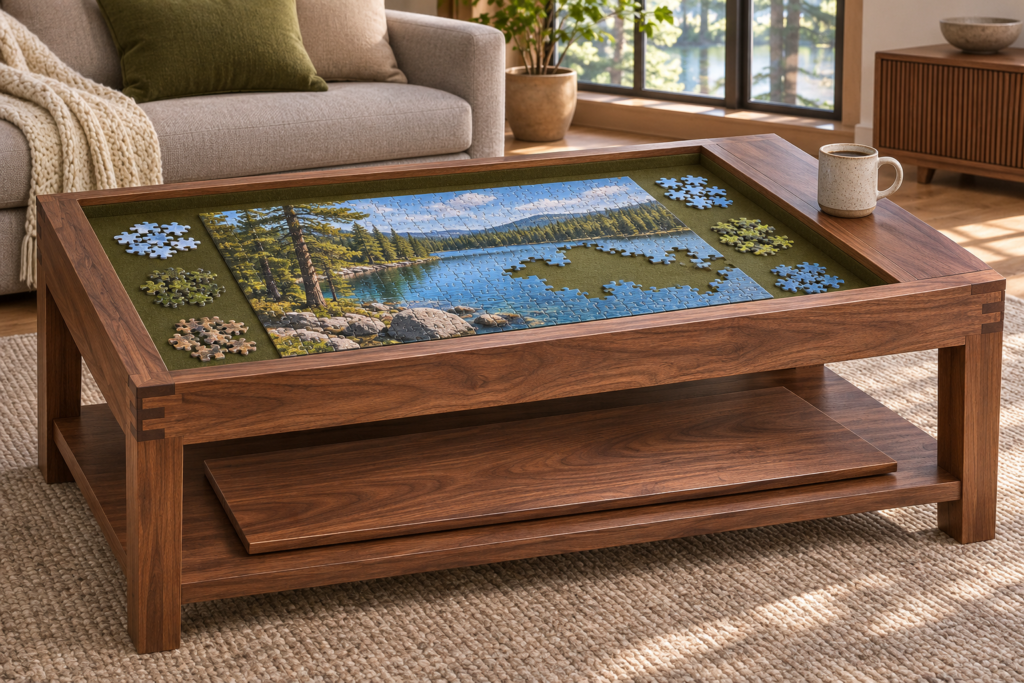
A tabletop with room underneath
Picture a low walnut frame surrounding a recessed puzzle tray lined with olive felt. A shallow rim keeps loose pieces from sliding off the edge when you sweep them into a group. Above the tray, a second ledge supports the removable tabletop. When the lid is in place, the frame carries the weight of mugs and books while the puzzle sits clear underneath.
When you’re ready to work, the lid slides onto an open shelf below. Two recessed grips would give you a place to hold it without reaching under a smooth edge. I’d use a walnut-veneered plywood panel for the lid and solid walnut where hands touch the frame. The piece you lift every evening should be easy to handle, even if the rest of the table has a substantial feel.
The tray would be sized for the puzzle you actually do. Check the finished dimensions printed on the box, then leave a band around the edges for loose pieces. If you like sorting pieces into little dishes, measure those as well. You could give the tray enough clearance to hold them under the lid or plan a spot on the shelf where the dishes can sit level.
The detail that decides whether you use it
My years in furniture retail taught me to picture a piece in the room during the busiest part of the day. For this coffee table, I’d picture someone sitting on the sofa with a cup nearby, another person walking past, and a guest reaching for a coaster. Where does the lid go? Where do the cups go when the puzzle is open? Can you reach the far corner of the tray without leaning across the pieces you just sorted?
Those questions shape the table. A narrow strip of fixed tabletop along one side would give a mug a place to land in either mode. In a room with seating on both sides, a square tray would let two people work from opposite edges. Against a sofa with access mainly from the front, a shallower rectangular tray would bring more of the puzzle within reach.
I’d also check how the lid comes off when the table is close to the sofa. If you have to stand, turn sideways, and maneuver it past someone’s knees every time, even a beautiful lid will spend most of its life on the shelf. The movement should feel as ordinary as reaching down for a book.
Try the idea with the table you already have
For your next puzzle, start on a rigid board you can comfortably carry with both hands. Use a second, smaller tray for loose pieces so the main board stays manageable. Before you begin, choose a flat place to set the board when you need the coffee table, such as a clear shelf or the top of a low cabinet.
Try moving the board once while it holds only a few pieces. Pay attention to where you grip it, whether you can keep it level, and whether anything blocks the path. You may discover that an open shelf within arm’s reach matters more to you than a lid. Or you may find yourself wishing the puzzle could stay right where it is when someone knocks. Either way, you’ll know what you want the furniture to do before you give it a permanent place in the room.