The drawer stops against the bed before you can see the shirt you want. You reach through the gap, lift the first folded pile, and feel another one collapse behind it. By the time you have the shirt, three sleeves are hanging over the drawer front. You close it with your hip and promise yourself you’ll reorganize it over the weekend.
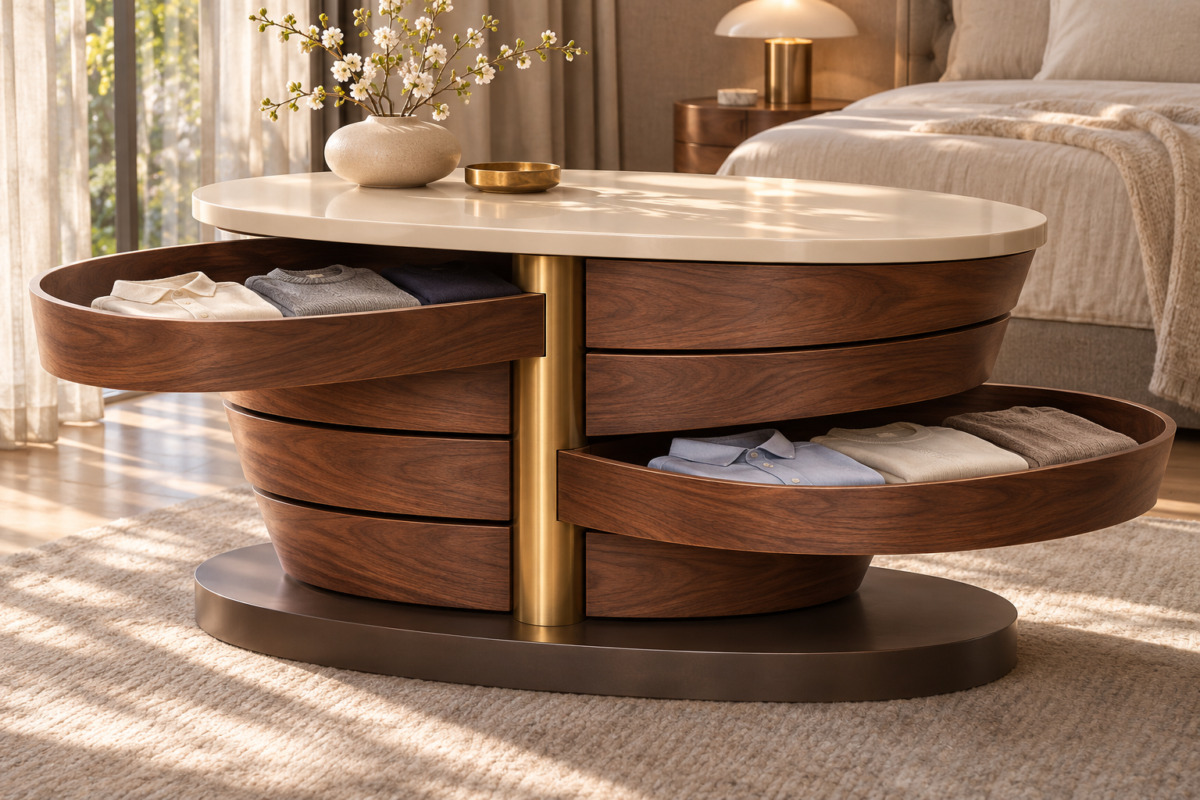
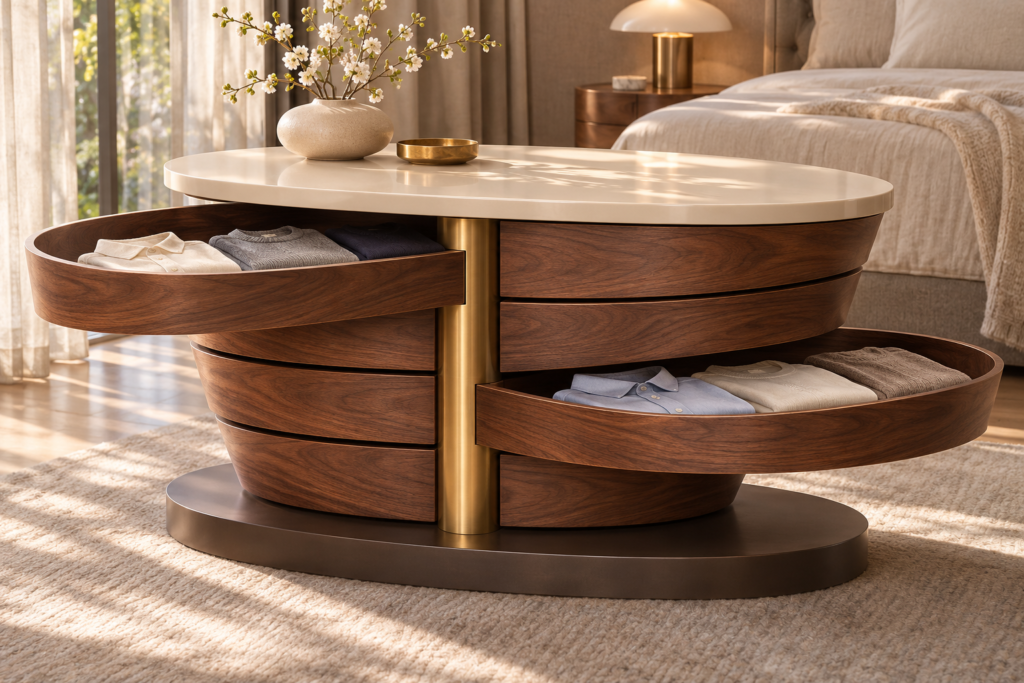
Imagine taking hold of the drawer’s edge and turning it. The entire shallow tray swings out around a brass spine. Your folded shirts appear in a single layer, visible from above. A second tray can turn the other way, making the dresser look like a flower caught halfway through opening. You take what you need and bring the tray back under the oval top.
This is a speculative bedroom furniture concept. A low chest would trade its straight drawer slides for trays that rotate around a fixed center. The idea would suit a room where seeing a whole tray matters more than fitting the largest possible quantity behind a rectangular front.
Build the storage around the turn
I picture five broad walnut trays below a cream oval top. The top would stay still, so a lamp or a bowl for keys could remain where you put it. Each tray would wrap around a central brass-colored steel column, supported on its own bearing. A wide fixed base would carry the column and keep the lower tray clear of the floor.
The trays would have rounded outer edges and a shallow lip all the way around. That lip would be high enough to hold folded clothes as the tray moves, with a generous handhold shaped into the edge. The middle would contain the bearing and its guard, so the useful storage area would curve around it. Think about socks following that curve in short rows and shirts sitting in broad groups nearer the outer edge. A tall stack would defeat the reason for making the tray shallow.
There’s a real precedent for rotating storage. Konstantin Grcic’s 360 Container uses individual units that swivel from a vertical pole. Magis documents the existing piece as a drawer unit with ABS compartments and a stainless steel joining tube. The imagined dresser would explore that principle at clothing scale, with broader trays and a fixed base. Grcic’s project description and Magis’s product documentation.
The beautiful spiral has a mechanical limit
If every tray could turn freely in every direction, the bedroom would soon become an obstacle course. I’d give each tray a defined opening arc and a positive stop at its useful position. The front edge could turn toward whichever side had more space. A mechanical interlock could limit how many trays open at once, with its exact arrangement decided through stability testing. The illustration shows the visual idea with two trays turned out.
That limit would be part of the furniture’s everyday feel. You might close the shirt tray before opening the one for sweaters, or have one shallow tray for small things available while you choose a shirt. The closed position should be easy to find by touch. I’d want a soft catch that tells you the tray is home without requiring a hard shove.
The bearings would need testing with the load piled at the outside edge. A tray full of shirts can move its weight away from the base as it opens. Someone leaning on the exposed tray adds another load in the same direction. A furniture engineer would need to establish the base, attachment, anchoring, and opening limits as a complete system. The CPSC’s Anchor It guidance is relevant when planning clothing storage at home, including how furniture is secured. CPSC’s furniture safety guidance.
Measure the sweep beside the bed
From my years in furniture retail, I’d start by standing in the place where you actually get dressed. A dresser can fit beautifully against a wall while leaving you nowhere to stand with its storage open. For this concept, I’d draw the full arc of the tray on the floor plan and check it against the bed corner, bedroom door, and the spot where a laundry basket normally lands.
The curve could bring the far side of a tray into view, but it still takes up floor space when open. Its outer corner might swing into the walkway even when the opening looks small from the front. A dresser beside a doorway would need particular attention. I’d check that the door can open and that another person can pass while someone is using the tray.
Capacity would also be a trade-off. The column takes up space in the middle, and the oval outline leaves less room for square stacks than a rectangular box of the same outside width and depth. I’d use it for the clothes you choose every morning. Bulky spare bedding could live elsewhere. Before buying any shallow dresser, measure one of your normal folded shirts and the height of the stack you naturally make. If the drawer only works after you learn a folding routine you dislike, the proportions need another look.
For a real purchase, ask the retailer for usable internal dimensions and the clearance with the drawer fully open. Handles and projecting fronts can add to that distance. Bring the dimensions of your folded clothes with you so you can compare storage you will actually use.
Try the whole-tray view today
Take one drawer out of use for ten minutes and lay its contents in a shallow basket or on a clear surface. Arrange the things you reach for most often in a single layer. Notice how much space they take and which pieces still need stacking. This gives you a useful target for drawer depth before you look at new furniture.
Then close the drawer and mark how far it needs to open before you can see that first layer clearly. Stand in your usual place, put the laundry basket down, and repeat the opening. If you want to explore the spiral idea, cut a cardboard outline of a tray and turn it around a marked center on the floor, keeping it clear of the door. Watch the outside edge as it swings. You’ll know where the storage can move, where you can stand, and whether the room would gain anything from a different kind of opening.
Further reading
- Konstantin Grcic Design — 360 Container. The designer explains how individual storage units swivel around a vertical pole.
- Magis — 360° drawer unit. The manufacturer documents the materials and structure of its existing rotating drawer unit.
- U.S. Consumer Product Safety Commission — Anchor It furniture safety guidance. Find guidance on securing furniture and reducing tip-over hazards in the home.