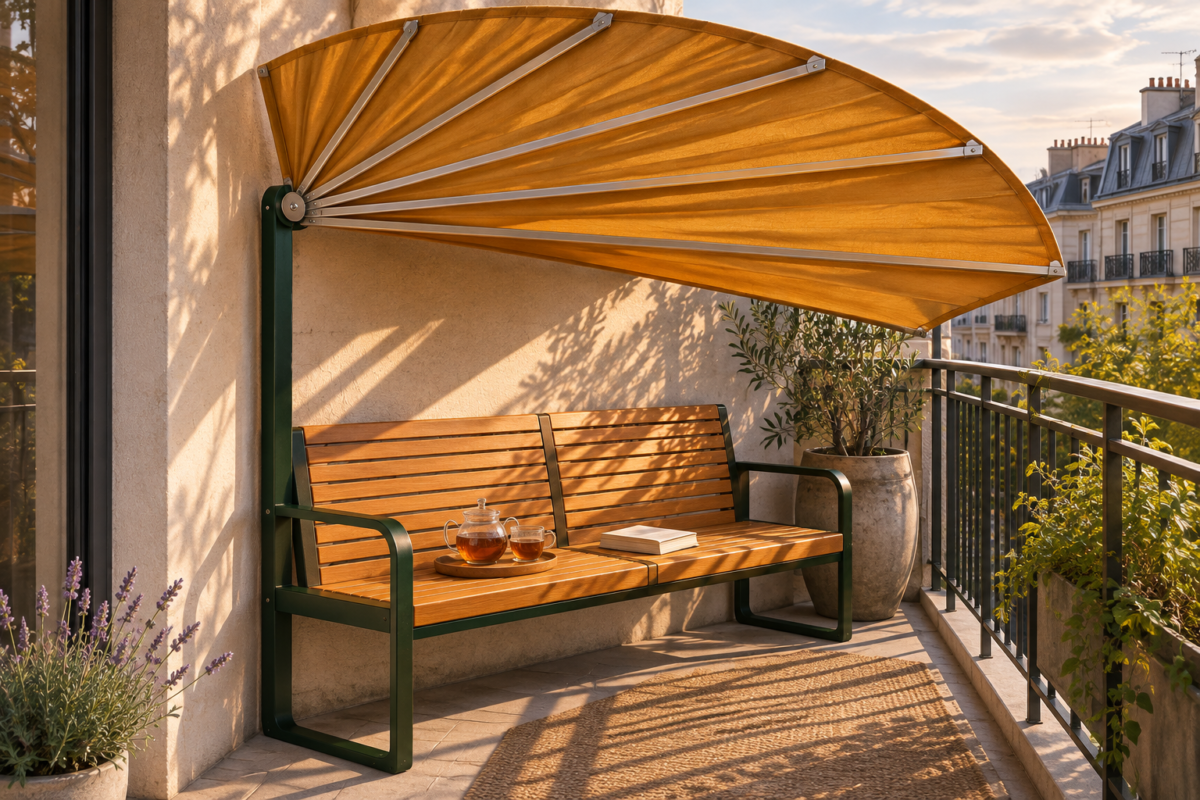
You set a paperback and a glass of iced tea on the balcony bench. By the time you find your place in the book, the afternoon sun has slipped past the edge of the building and landed squarely on the page. You scoot toward the wall. The only patch of shade left is behind a plant pot. An umbrella might help, if there were anywhere to put its base without stepping over it on the way back inside.
Imagine reaching to the side of the bench and drawing out the first rib of a giant folding fan. The ribs spread overhead. A quarter circle of ochre fabric tightens above the seat, and the shadow slips across the book. From the kitchen, the shade looks like a wing that grew out of the furniture.
This is a speculative balcony bench concept. It would borrow the motion of a handheld folding fan to make a temporary roof over a two-person seat. When the fabric is folded away, the bench would leave the balcony open to the sky.
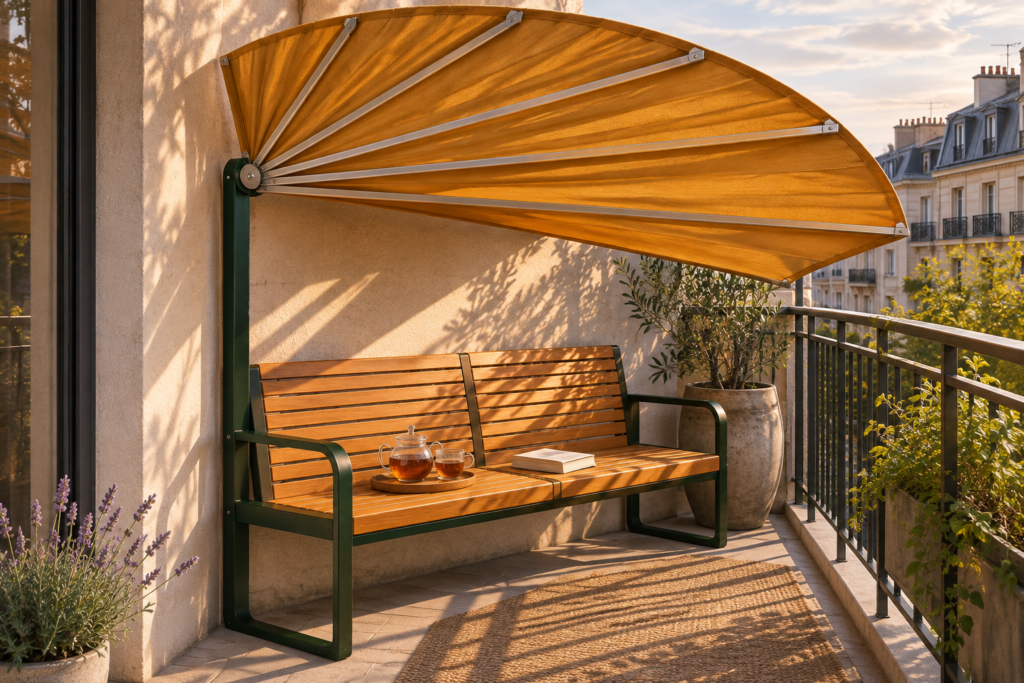
A canopy that opens from one corner
I picture a slatted wood seat on a deep green aluminum frame, with one upright rising behind the bench at its far end. The top of that upright would carry a stack of nested ribs on a single pivot. Pull the leading rib and it would swing over the seat in a shallow arc, opening the cloth between the other ribs as it goes. In its closed position, the stack would tuck close to the back wall, with a clip keeping the ribs together.
The geometry is easy to see in a handheld folding fan. Its sticks meet at a pivot and spread into a sector when it opens. At balcony scale, the pivot would sit above head height and to one side of the seat. The leading rib could connect to a handle on the upright so you could open the shade from below. The canopy’s shape would be cut to cover the bench without swinging out over the railing. The Met’s folding fan collection entry.
I’d want at least two useful positions for the fan. Partly open, it might shade one person and leave the rest of the seat in the sun. Fully open, it could cover both places. A positive latch at each position would matter more than the smoothness of the opening gesture. If the fabric were loose enough to flap over the book, the seat would be frustrating to use on an otherwise pleasant day.
What the wind asks of the furniture
A fan that opens sideways would give the wind something to push against. The mast and the connection to the base would need to be designed for that force, and a qualified designer would need to establish whether the furniture could stand safely on its own or required an approved mounting point. A heavy seat on its own would tell you very little about how an open canopy behaves in a gust. If a balcony couldn’t accommodate the mounting and loading requirements, I’d leave the idea on the drawing board.
One reason to keep the canopy modest is that it should be easy to close when conditions change. A person standing beside the bench should be able to release the latch, draw the ribs together, and secure the stack in one continuous action. Real offset parasols have their own operating and closing instructions. Tuuci’s manual, for example, calls for closing its umbrella in windy conditions. A folding bench canopy would need its own tested limits and instructions. Tuuci’s cantilever umbrella instructions.
I’d make the fabric removable for cleaning and check where water goes when the fan is folded. A shallow pitch in the open ribs could keep the fabric from sitting flat, but the first prototype would be a sunshade. A canopy designed to stay open in rain would raise its own questions about drainage and pooling. The nice version of this idea would be light enough to operate often and straightforward enough to put away before you go inside.
Where the shadow actually lands
From my years in furniture retail, I’d think about the position of a seated person before sizing the canopy. The shadow can cover the slats while leaving your eyes in bright light. On a west-facing balcony at the end of the afternoon, a horizontal canopy may do little for sun coming in low from the side. I’d use the bench’s orientation and the angle of the canopy to place shade where you want it, then check those choices against the hours you actually sit outside.
Floor space is the other half of the buying decision. A narrow balcony may have room for the bench with the door shut and very little room when the door is open. A fan that avoids a separate umbrella base still needs space for its mast, the feet of the bench, and the path of the ribs as they open. Measure the depth of the seat you enjoy sitting on, then ask how much space you need in front of it to stand up with a drink. That measurement is more useful than a catalogue photo of an empty balcony.
I’d also check what happens when only one person wants shade. If the far end of the seat faces a view and the other end faces a wall, the partial-open position ought to protect the place someone is likely to choose. That one decision could determine which end gets the upright.
Try a chair-sized shade test
At the time you usually go outside, put a chair where you’re considering a bench. Sit there for a few minutes and notice where the sun reaches your face, hands, and lap. Mark where the chair legs sit with removable tape. Come back later, check the same spot, and write down what changed. Repeat with the chair facing a different direction if there’s room. Keep the exit clear as you try each layout.
If the shadow crosses the seat just when you want to use it, try the spot for a week before buying anything. If the light comes in low from one side every time, you’ve learned what an overhead shade would have to contend with. Either way, you’ve found out where the chair belongs at the hour it matters.
Further reading
- The Metropolitan Museum of Art — Folding fan with a jeweled pivot. Look at how the ribs of a handheld folding fan spread from a single joint to support an open surface.
- Tuuci — Cantilever umbrella operating instructions. This manual shows how a real offset parasol operates and explains when its canopy should be closed.