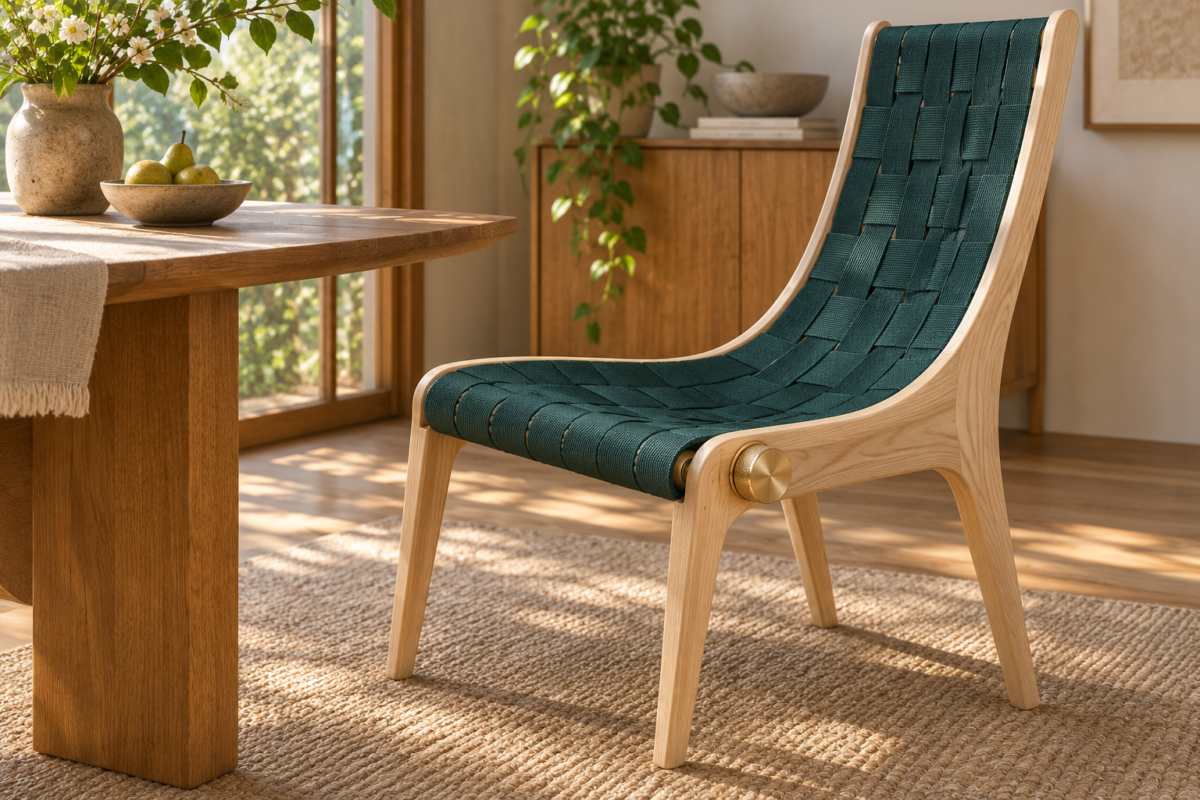
The plates have gone back to the kitchen. Someone has poured more tea, and a story that started at dinner is getting better with every interruption. You shift forward, then sideways, then hook one foot around the chair leg. The chair was pleasant enough while you were eating. An hour later, you’re looking across the room at the sofa.
Imagine standing for a moment and turning a brass dial beneath the seat. The woven surface settles into a deeper curve. You sit back down, and the chair gives a little more under your weight. The table is still close enough for tea, but you’ve stopped sitting as though the next course is about to arrive.
This is a speculative dining chair concept. A continuous woven sling would change tension between a firmer dining setting and a more yielding setting for the conversation afterward. The frame would keep its place around the table while the surface inside it changed shape.
A wooden frame with a changeable surface
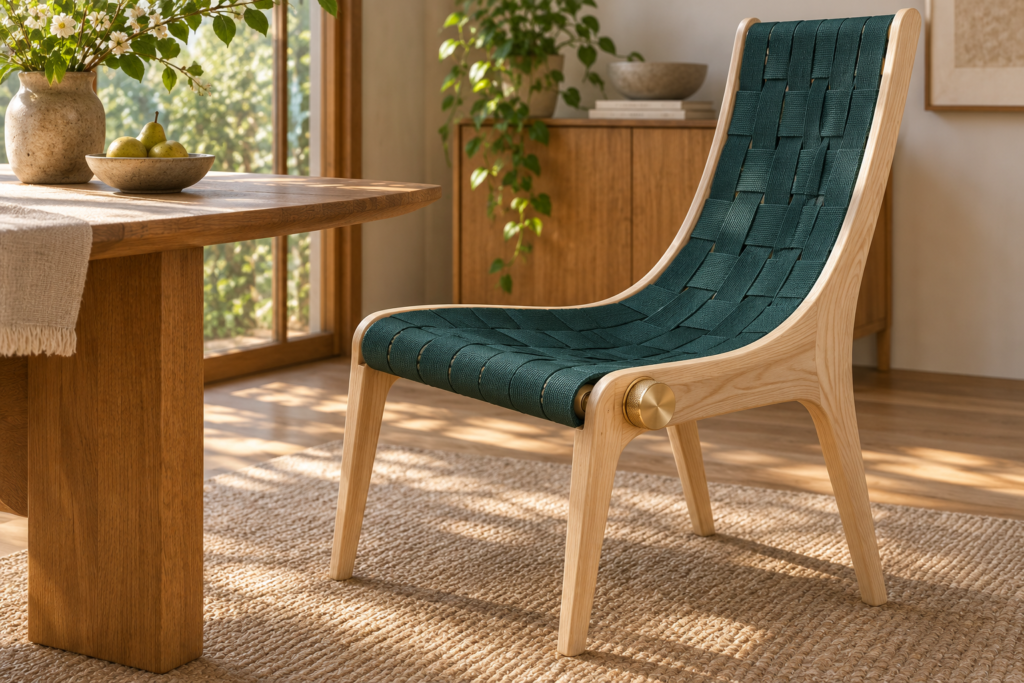
I picture an ash frame with four feet and side rails that sweep from the front of the seat up behind the shoulders. Dark teal straps would weave across a continuous seat and back, leaving narrow spaces where you could see through the chair. The wood would carry the structure. The sling would carry the sitter within that structure, with room to change its curve without touching a rigid rail underneath.
The front edge of the sling would wrap around a concealed roller under the seat. A guarded mechanism at the roller would take up or release a limited length of material. At the back, a fixed attachment would hold the other end. Turn the dial toward the dining position and the surface would become shallower. Turn it toward the relaxed position and a small amount of slack would settle into the seat and lower back.
Webbing already has a place in dining furniture. Knoll’s Risom Side Chair pairs woven cotton straps with a hardwood frame. That existing chair is useful to look at for how a network of straps makes a supporting surface. The proposed adjustment would need a different attachment and tension system, designed and tested for repeated movement. Knoll’s Risom Side Chair.
Small motion would have to do a lot
The change would need to be controlled. Release too much material and you could sink into the seat with your knees higher than you wanted. Take up too much and the webbing could feel hard along the front edge. I’d start with two defined positions and a narrow range between them. The dial should stop positively at either end, with a visible mark you can find without crouching below the table.
I’d make the adjustment with the chair empty. The mechanism could then move the fabric without fighting the sitter’s weight, and the person using it could check that it had latched before sitting down. A prototype would need to hold both settings under uneven loads and repeated sitting, with particular attention to the roller, webbing attachments, and the point where the woven seat turns up into the back.
Changing support as someone moves is a real furniture design challenge. Herman Miller’s Setu uses a flexible spine to vary resistance through movement. It offers a useful example of how much of a chair’s behavior can come from the supporting structure. For this dining concept, the proposed control would alter the fabric surface by a set amount before someone sits down again. Herman Miller’s Setu brochure.
The table still decides whether the chair works
From my years in furniture retail, I’d try the chair with the table it will actually live beside. A chair can feel inviting on its own and put you too low once a plate is in front of you. Check where your elbows fall, whether your feet reach the floor comfortably, and how the table edge meets your body. Then put the chair into its softer position and do the same check with a cup in your hand.
The tabletop apron matters too. A deeper sling might leave more room above your thighs while changing the way you rise from the seat. You should be able to move your feet underneath you and stand without pulling the whole chair toward the table first. If there are arms, check whether they clear the apron and whether the chair can tuck away far enough to keep the walking route open.
Width is worth measuring where it affects daily life. Measure between the table legs and compare that with the chair’s widest point. A sculptural rail can flare out just where two chairs need to sit beside each other. I’d leave enough room to pull out a chair while the neighboring one is occupied, then walk past both with a tray. That is the moment a beautiful dining set has to earn its space.
What would wear, and what could be replaced
The dial would be the part you notice in a photograph. The webbing edges and attachments would tell you more after a few years of use. I’d want the sling to be replaceable as a complete assembly, with instructions for fitting it and establishing the correct tension. Individual straps that stretch at different rates could leave you adjusting the same chair repeatedly.
Cleaning would also shape the design. Ask about the exact fabric, the maker’s cleaning instructions, and what happens if a drink reaches the adjustment housing. A removable guard below the seat could provide service access while keeping fingers away during use. The most useful version of the chair would make the occasional repair understandable to the person who owns it.
Try the after-dinner chair test
At home, sit in your dining chair for a few minutes with an empty plate on the table. Notice where you settle while you eat. Clear the plate, lean back as you would for conversation, and stay there with a book or a cup. Pay attention to the seat edge, the support behind you, and the place your feet find. Then stand up normally.
If you’re shopping, repeat that sequence with the exact chair and a table of similar height. Bring the table measurements with you. The setting you enjoy for a quick meal may be different from the one you want for a long evening, and a few extra minutes in the showroom can make that difference clear.
Further reading
- Knoll — Jens Risom’s woven side chair. See a real hardwood dining chair that uses woven straps for its seat and back.
- Herman Miller — Setu chairs brochure. The manufacturer explains how a flexible spine changes resistance as a sitter moves.