The thread catches on your sleeve just as the phone rings. There is an embroidery hoop on the table, scissors beside it, and a half-sorted collection of colors that took longer to arrange than you expected. You need the room back for the evening. Packing everything away means starting that little sorting job again tomorrow.
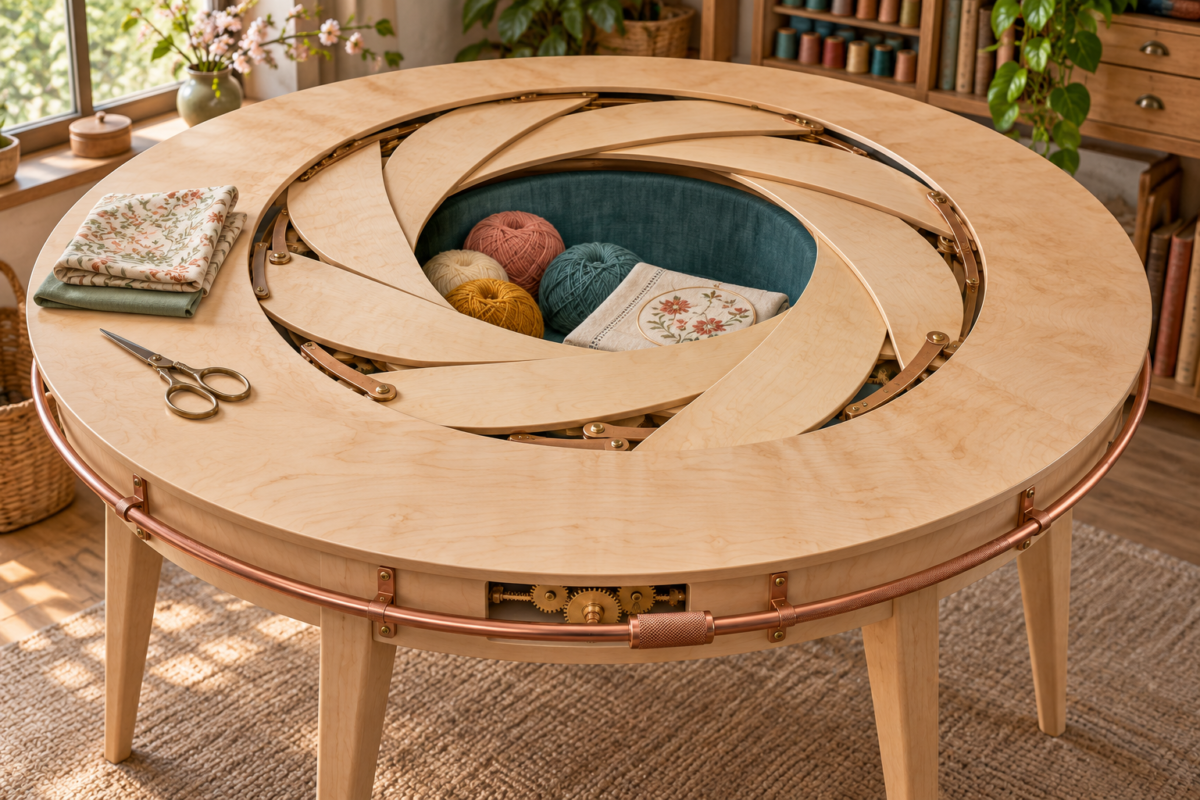
Imagine turning a copper-colored ring around the edge of the table. Curved wooden leaves sweep inward over a recessed project bowl, closing like the aperture of an enormous camera. Your needlework stays below, while the top becomes a sculptural spiral. Tomorrow, a turn in the other direction opens the table’s eye onto the work you left waiting.
This is a speculative sewing table concept, not a product or a tested mechanism. Its unusual idea is a furniture-sized iris shutter that changes how much of a central project well is exposed. A fixed outer ring would remain available for your hands and tools throughout the transformation.
A table with an adjustable opening
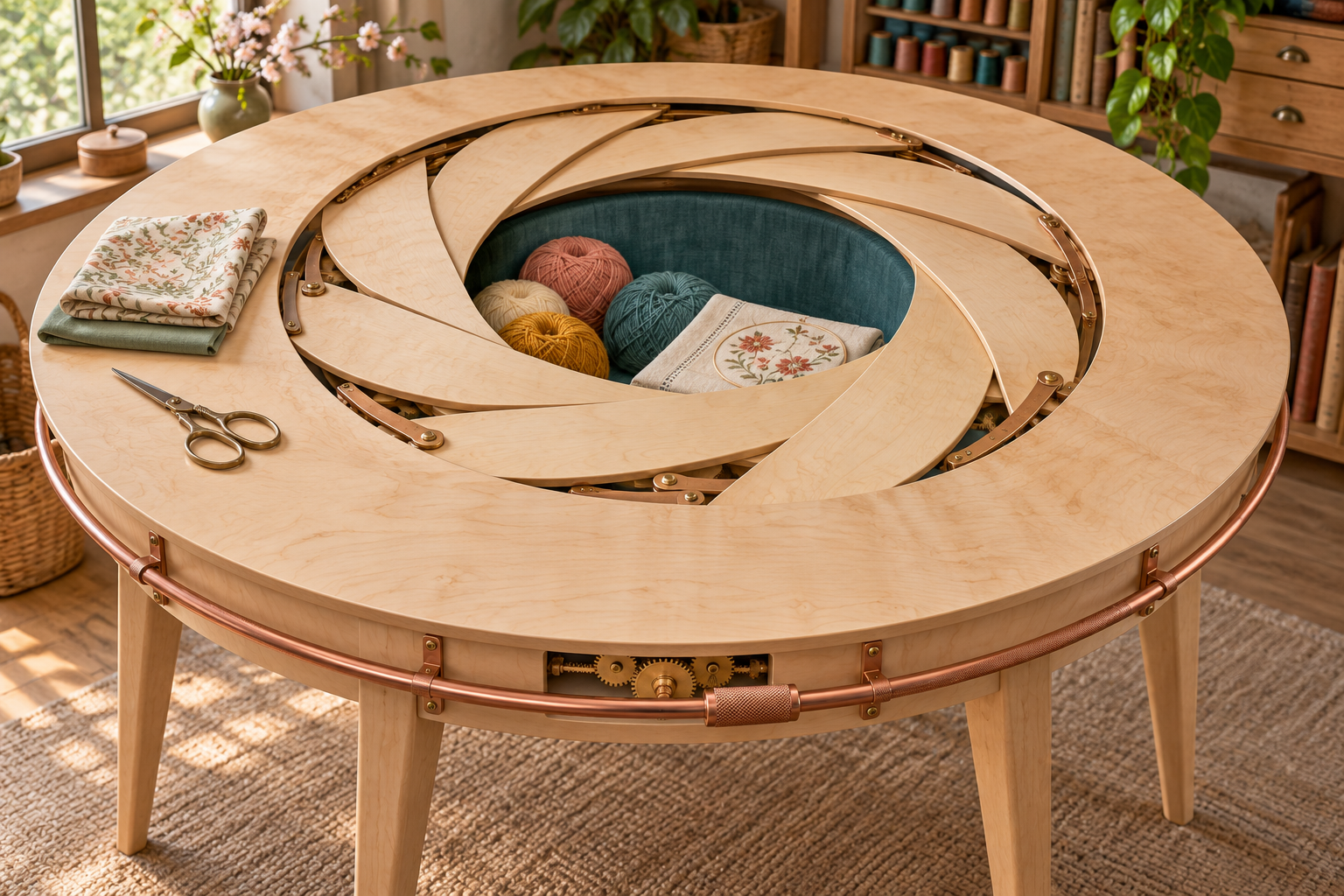
Picture a round birch-faced table with a teal-lined bowl beneath its center. The bowl would hold a modest hand-sewing or embroidery project, with small removable containers for thread and notions. Around it, overlapping curved leaves would travel in a shallow mechanism housing. Their edges would form a changing circular opening.
The opening could be wide while you select materials, narrower while you work with a single piece, and closed when the project is put to bed. That variable opening is the reason to consider an iris instead of an ordinary hinged lid. There would be no tall lid between you and someone sitting opposite, and no detached cover to lean against a wall.
The central shutter would not be the main work surface. Its overlapping leaves would create seams and changes in level. The fixed perimeter would carry the everyday tasks, while a removable rigid board could provide a continuous surface when the shutter is closed. That board would need its own accessible storage slot beneath the table.
Borrowing movement from optical equipment
Edmund Optics describes iris diaphragms as thin leaves arranged to create a circular aperture that can open and close. In optical equipment, that opening controls light. Here, the borrowed idea would control access to materials. The manufacturer’s iris diaphragm overview shows the real mechanism family.
A proposed furniture version would connect each leaf to a stationary pivot and a guide in a rotating drive ring. Turning the outer control would move those guides together, sweeping the leaves inward or outward. The exact geometry would need development in models before choosing the leaf count, thickness, or maximum opening.
Simply enlarging an optical component would not produce a serviceable table. Wooden leaves would have different weight, stiffness, and surface behavior from thin optical blades. I would explore a stable laminated construction, replaceable low-friction contact pieces, and a removable underside access panel. The illustration expresses the intended movement; it is not a construction drawing.
Keep the thread out of the machinery
Loose thread is the design’s most obvious adversary. A strand caught between overlapping leaves could be pulled across a project or wound into a guide. The bowl would therefore need a clearly marked fill line below the shutter’s path, with a smooth inner guard separating stored fabric from moving parts.
Closing would be a deliberate, empty-hands operation. You would first secure needles, put scissors in their holder, tuck loose ends into the bowl, and check that nothing crosses the rim. A hand-driven control with limited force would be worth investigating, but a gentle feel alone would not establish safety. Pinch points and trapped objects would need their own tests.
I would also want a positive stop at the fully open position and an accessible way to reverse the motion if something snags. A motor could make the opening theatrical, yet it would introduce power, controls, and additional fault conditions. For this concept, a manual ring makes the sequence easier to understand and the resistance easier to notice.
The project bowl has a furniture ancestor
There is a real historical connection between a small worktable and a container for unfinished needlework. The Metropolitan Museum of Art documents an American worktable dated 1800–1810 whose lower slide holds a silk bag for needlework. The Met’s collection entry describes that arrangement.
The proposed table would bring the container up into the center, where you could see its contents without pulling out a drawer. Its liner should lift out separately for cleaning. Small lidded containers could keep beads or needles from disappearing into the fabric lining. These would be organization choices for the imagined bowl, not evidence that the iris itself works.
Depth deserves restraint. A deep well could hold more yarn and still be frustrating if every useful item sits beneath another. I would design around one active project and a limited selection of tools. Long-term supplies could stay in ordinary storage. The aim would be to preserve the next step in the work, rather than swallow the entire hobby.
Would it be comfortable to use?
From my years in furniture retail, I would start with the relationship between the person, the chair, and the task. A beautiful opening in the center is of little use if you must reach across a wide rim to retrieve every spool. The inner edge should be within a comfortable reach from the actual seat.
There also needs to be room below for knees. The bowl and drive housing would take up depth that a plain tabletop does not. Before choosing a table height, a prototype should be tried with different chairs and with someone leaning forward to inspect a stitch. Raising the table to clear the knees could make the work awkwardly high.
This would be a handwork table. A sewing machine, an iron, or a cutting task would need an appropriate dedicated surface. I would keep hot drinks on a separate side table as well. Spilled tea in an overlapping shutter would turn a pleasant evening’s work into a cleaning job involving every leaf and guide.
Try a project-well rehearsal today
Set a shallow basket or tray beside your usual work surface and put only your current project inside. Leave the tool you will need next in a small container at the top. Work for a short session, then stop with the project still unfinished. Notice what must be secured before you can carry the tray away.
Measure that tray and make a paper outline of the opening you would need to reach its contents. Lay the outline on your table, sit in your normal chair, and test the reach without leaning heavily on the edge. You can learn whether central access would help or whether a tray beside your elbow is already the easier arrangement.
Finally, cover the tray and return the next day. If you can resume without searching for colors, untangling thread, or remembering which needle you used, you have identified the useful promise of the concept. The iris adds a little science fiction to the room; keeping tomorrow’s first stitch ready is what would make it worth opening.
Further reading
Edmund Optics — How iris diaphragms form an adjustable opening. Learn how overlapping leaves control an optical aperture; this documents the real mechanism, not a validated furniture design.
The Metropolitan Museum of Art — American worktable with a needlework bag, 1800–1810. The museum describes a historic sewing table with a silk bag held in its lower slide.