The movie is paused, the tea is going cold, and you are sitting sideways on the sofa because someone else has claimed the comfortable corner. Across the room sits an ottoman: useful for feet, disappointing when you want to lean back. Bringing in another armchair would solve tonight’s problem and occupy tomorrow’s walking space.
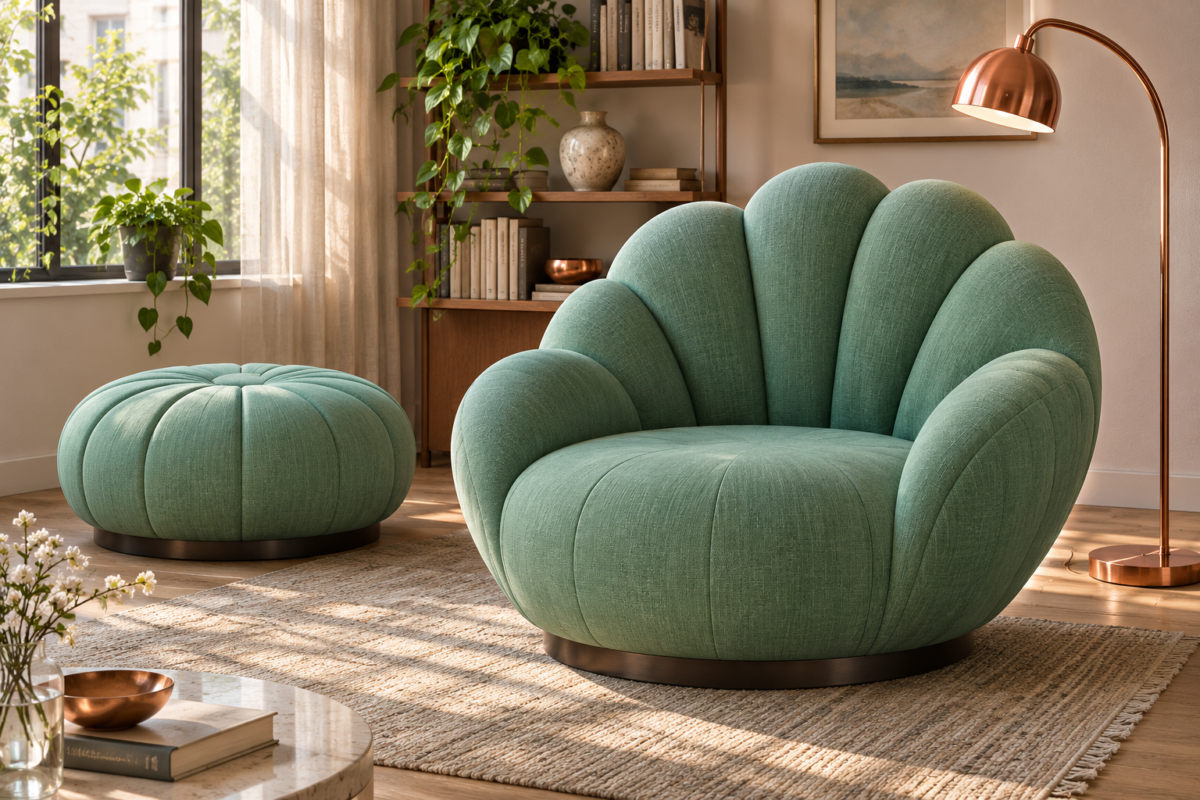
Imagine tapping a control on that ottoman. Its pleated rim begins to rise. Rounded fabric ribs lift behind the seat, curl inward at the sides, and settle into the silhouette of a sea anemone. What was a low upholstered drum becomes an enveloping lounge chair. The room seems to have grown a new place to sit.
This is a speculative furniture concept, not an available product or a tested prototype. The idea is an ottoman whose air-supported outer shell changes into a backrest and arms. Its central seat stays on a permanent structural base. The transformation would change the way you use one piece, rather than merely reveal a pocket or add a charging port.
A soft shell with two distinct shapes
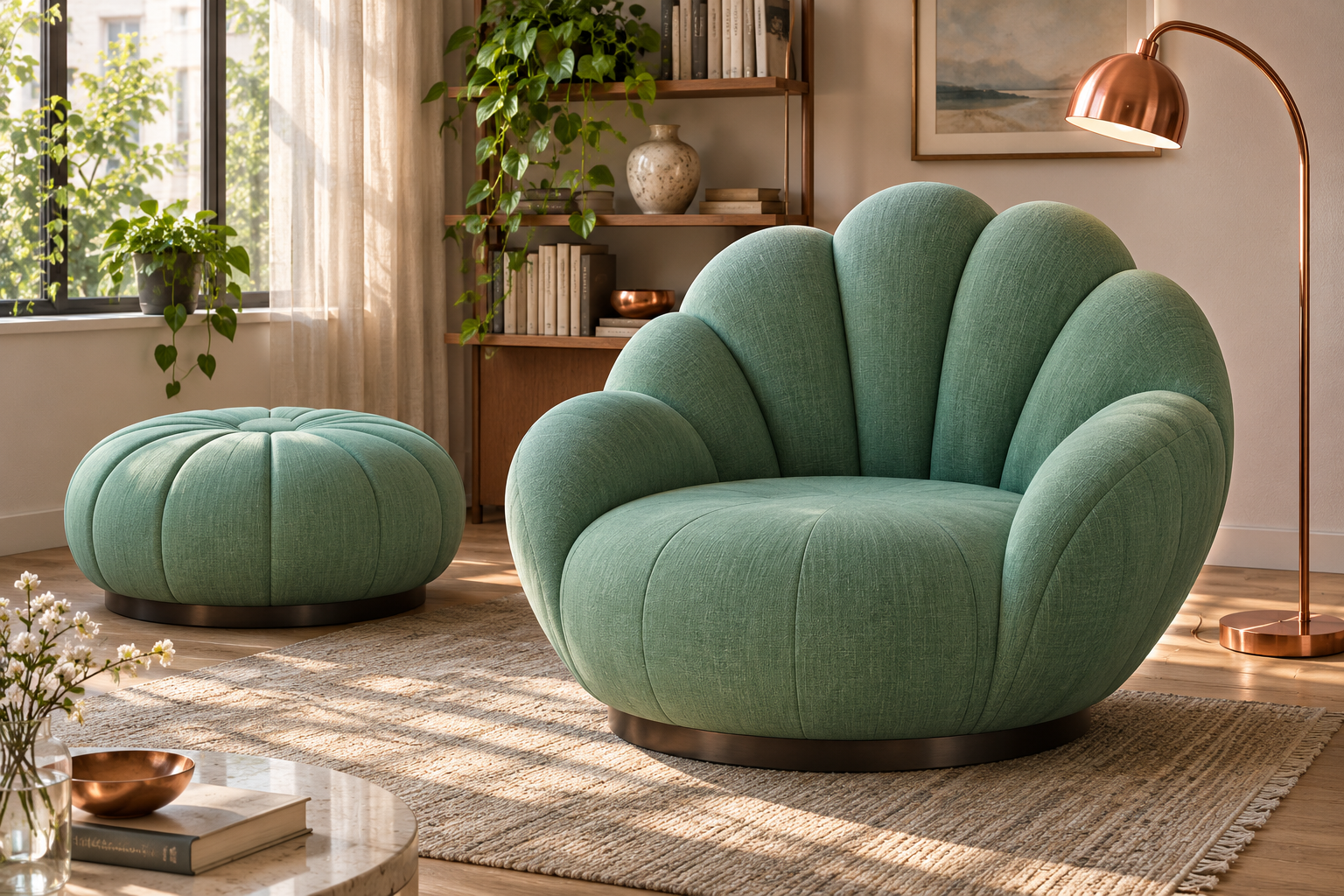
I picture sea-green woven upholstery over separate internal air chambers, with a dark circular plinth under the seat. In footrest mode, the empty chambers would gather into broad pleats around the perimeter. In chair mode, five taller chambers would create the back and shorter chambers would form the arms. The illustration shows those two imagined states together.
The fabric would need enough allowance to unfold without becoming a loose sack when collapsed. Shaped seams and internal tethers could guide each chamber into a curved rib instead of a round balloon. A removable outer cover would separate the surface you touch from the airtight layer doing the shaping. That separation could also make cleaning and replacement more manageable.
This would be a substantial change of posture, from putting your heels on a low drum to sitting inside a supported shell. It would not make the chair disappear. The permanent seat and base would still occupy floor space, and the raised shell could spread beyond that footprint. Both outlines belong on the room plan.
Air does the shaping; the base carries the seat
A proposed low-voltage pump would fill the back and arm chambers through individual valves while the furniture is empty. Internal webbing would limit expansion and set the backward curve. A controlled release would let the chambers soften and fold back into their perimeter pockets. The design would need a clear ready indication before anyone used the backrest.
Inflatable seating has a real design history. MoMA’s collection records the 1967 Blow Inflatable Armchair by Paolo Lomazzi, Donato D’Urbino, and Jonathan De Pas. The museum explains that air gives its PVC skin form. That is a useful precedent for thinking about an air-shaped volume, although it does not demonstrate this proposed transformation. See MoMA’s Blow chair entry.
Air can also create pulling movement rather than simply expand a cushion. Festo describes its Fluidic Muscle DMSP as a polymer tensile actuator with contraction characteristics. A future development team might explore tension elements to guide the ribs as they rise. Industrial pneumatic hardware would not be a ready-made domestic solution; its pressure supply, controls, and behavior would require a separate design. Read Festo’s actuator description.
What happens when a chamber loses air?
The central seat would have its own frame and padding, so its basic support would not depend on an inflated ring. The backrest is the harder question. If someone leans back and a chamber loses pressure, the furniture needs a predictable way to limit movement. A proposed internal restraint could catch the shell before it drops too far, but that arrangement would need testing with the whole chair.
Separate chambers could make a damaged rib replaceable, yet separation introduces more valves, seams, and connections. A prototype would need repeated inflation cycles, uneven loading, and deliberate leak tests. It would also need testing when someone pushes on an arm to stand up. A soft arm that feels pleasant while reading may be unsuitable as a dependable standing aid.
The base would need enough stability for a person leaning sideways toward a table. Its weight, width, and floor contact would have to be resolved together. There is no honest load rating to print at the concept stage. The illustration conveys the desired shape; it cannot establish the strength of the shell, frame, or restraint.
The everyday costs of a small transformation
Pump noise matters in a room used for conversation and television. I would want the transformation completed before the film starts, with the pump off while someone sits. Holding the shape without constant topping up would be a development goal. If it needed frequent bursts of air, the mechanism could quickly become the most noticeable thing in the room.
Cleaning would matter just as much. Deep seams can be awkward places to reach with a vacuum attachment. The pleated rim should open far enough for access, and the cover should come off without disconnecting a maze of tubes. A serviceable design would let an owner replace a cover or damaged chamber without discarding the seat.
From my years in furniture retail, I would begin with what someone expects from the chair after the surprise has worn off. Can they sit comfortably, reach their cup, and stand without a struggle? The sea-anemone shape might suit a reading corner, but it could feel too enclosing for someone who likes a straight back and open sides. A conventional armchair may be the better purchase for that person.
Try the two-posture test today
You can test the useful part of this idea with furniture you already own. Place an ottoman where you normally put your feet, then move it away and put a comfortable chair in that general area. Sit in the chair while someone uses the sofa. Check the sightline to the television and the route between the seats and the doorway.
Measure the occupied arrangement, including knees, feet, and the space needed to stand. Then measure the footrest arrangement. Write down which use matters more during a normal week. This gives you a practical brief before shopping for an ottoman, accent chair, or compact lounge seat.
Finally, check the table from both positions. A surface that is easy to reach from the sofa may require an awkward stretch from the extra chair. Moving a small side table could solve more of the evening’s problem than adding a larger seat. The imagined breathing shell asks a useful question: which change in the room would actually make you comfortable?
Further reading
MoMA — Blow Inflatable Armchair, 1967. Explore the designers, material, and air-supported form of this real inflatable chair.
Festo — Fluidic Muscle DMSP. The manufacturer documents a real pneumatic pulling actuator; it does not validate or endorse this furniture concept.