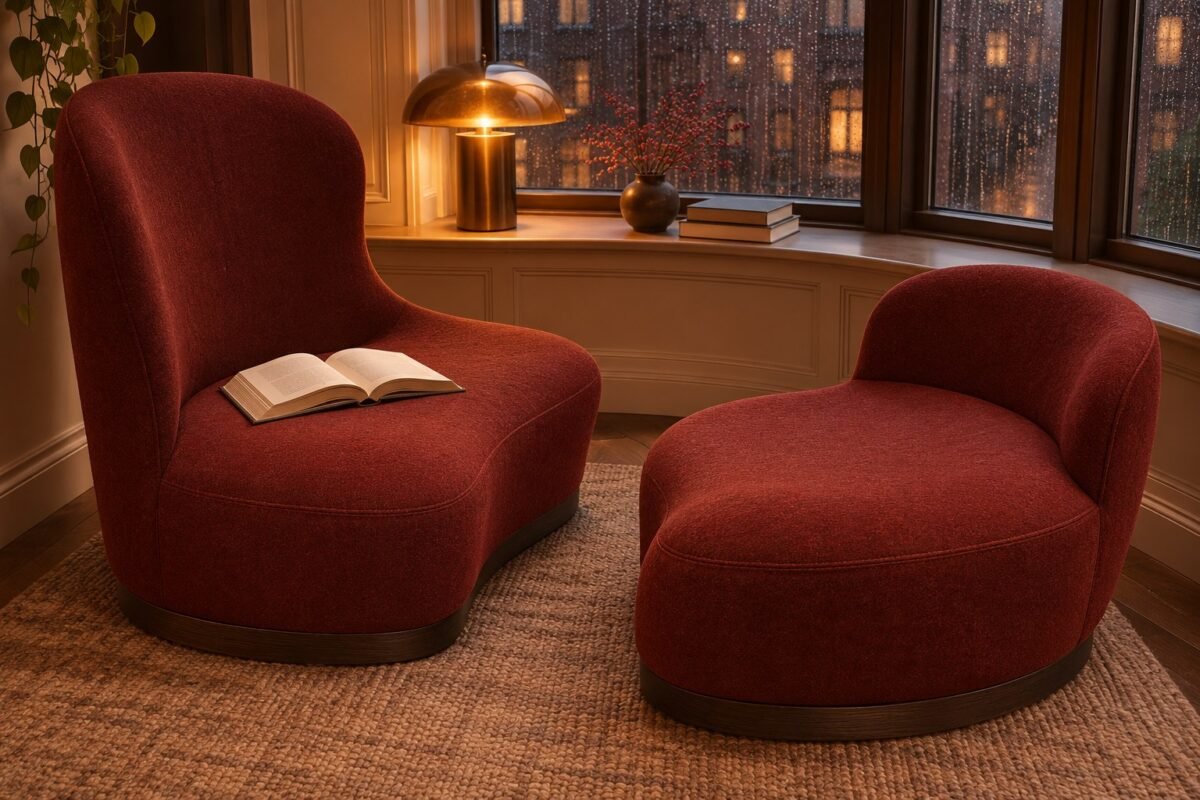
Rain is tapping on the bay window, and you’ve finally reached the chapter where the detective admits she knew the victim. Then there’s a knock. Your neighbor is standing in the hall with a paper bag of pastries and news too good to tell from the doorway. You have a lamp, two cups, and exactly one good seat. The kitchen chair would fit if you moved the plant, but it would also leave one of you perched upright while the other sank into the cushions.
Imagine standing up, pressing a small pedal at the foot of the chaise, and drawing its front half sideways. As you turn it toward the window, you reveal a low backrest that had been nested alongside the main seat. You set the piece down beside the lamp. Your neighbor has a proper chair, and you can still sit in the spot where you left your book.
This is a speculative furniture concept for a reading nook. One long lounge seat divides into two independently supported chairs, then joins back together when you want the room to yourself.
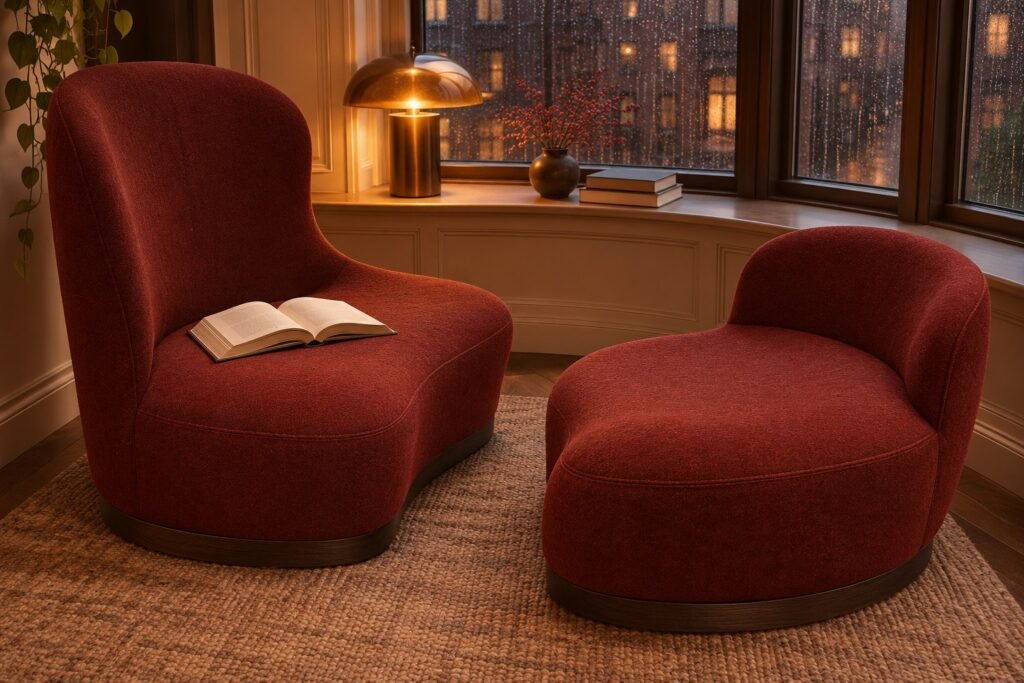
Two chairs meet along a curve
Seen from the doorway in reading mode, the piece would look like a single ribbon of deep red wool on a smoked ash base. The taller end would have a generous back for settling into a book. The lower end would carry your calves and heels. Between them, a shallow S-shaped seam would show where the upholstered shapes meet. Each half would have its own frame all the way down to the floor.
The trick would be to give the shorter half a backrest that serves both arrangements. Picture a low upholstered ridge on one long side. When the pieces are joined, that ridge continues the edge of the main chair and leaves the middle clear for your legs. When the smaller piece turns about a quarter turn, the ridge sits behind the guest. Now the broad area that held your lower legs becomes the seat. The cushions would need different shaping in different places so both uses feel deliberate. A generous curve under your calves might feel like a hollow once you sit in it.
There’s a precedent for treating a chaise as a shape the body can occupy in more than one way. Charles and Ray Eames’s La Chaise prototype takes its floating profile from a reclining figure. The useful lesson for this concept is to start with where people put their weight, then see what shape is left around them. Draw the reader, the guest, and the reader’s legs in all three positions before deciding where the seam should go.
The guest chair rolls only while you move it
The smaller chair would have a recessed carry grip and a set of small wheels inside the plinth. With both seats empty, you’d release a latch under the seam and press a pedal to shift the smaller chair’s weight from its fixed feet to the wheels. Once you reached the new spot, you’d lower it onto its feet again. Some industrial equipment uses that same division of jobs between a wheel and a stationary foot, as FATH’s caster documentation illustrates. A residential version would need its own hardware and testing.
Bringing the two halves back together should feel as straightforward as closing a door. Two guides under the frame could line up the cushions before the latch catches. The seam would still be visible, which gives the upholsterer a choice. A tailored seam that follows the curve can look intentional. A gap that widens after a few weeks of use would be irritating, especially if the edge is exactly where your knees rest.
I’d want to see a prototype tested for tipping when somebody sits on the very front of the guest chair or leans hard against its low back. I’d also want to see it cross a thin rug edge without a wrestling match. On thick carpet, the wheels might be the wrong approach altogether. A lighter module with sensible handholds could work better for a household that moves it rarely and has two people available to lift it.
The extra chair still needs somewhere to land
From my years in furniture retail, I’d start with the space around the piece when it’s doing its hardest job. In this case, that’s when two people are sitting down, the table has hot cups on it, and someone still needs to reach the window. Measure the nook in both arrangements. The chaise needs room for your legs in one position. In the other, both people need space to stand up without moving the table.
I’d also pay attention to seat height and firmness. If the guest half is much lower than the main chair, the change may look graceful and still be awkward for the person using it. Try chairs of different heights before settling on either one. There’s room for a taller guest seat in the design if the chaise rises gently at the foot. The important part is trying the two positions with people who have different preferences about how deeply they sit and how much support they want when they stand.
A single well-placed lamp could serve both layouts. Put it beside the main seat where it can light a book over your shoulder. Then check that the guest seat can turn far enough to face you without putting the lamp between your faces. If the only place for the second chair is directly in front of the first, the room may work better with an angled layout from the start.
Try the two-seat layout before buying anything
Start with your favorite chair and a small table. Sit with a book and notice where your feet naturally land. Put a sturdy ottoman there if you have one, or mark the area with painter’s tape. Now remove the ottoman and use a second chair you already own to stand in for the guest seat. Try it at a slight angle to the main chair, with a clear route from the doorway.
Sit in both chairs. Check where a mug would go, how you’d stand, and whether you can talk without turning your neck the whole time. If the guest chair takes up too much room, try moving the table to the outside of the pair before moving either seat. The next time someone knocks, you’ll already know where to put the second chair. And if you’re still reading, you’ll know exactly how much space the room can lend you for putting your feet up.
Further reading
- Museum of Modern Art — The Eameses’ La Chaise prototype. The museum traces the sculptural lounge chair to a reclining figure and explains how the designers made its molded form.
- Roche Bobois — Hans Hopfer’s Mah Jong modular seating. The manufacturer shows how independent floor-level seating elements can be rearranged for different uses.
- FATH — Swivel and fixed casters with lifting feet. This industrial hardware example shows how a pedal lets equipment roll on wheels and then rest on stationary feet.