The video call starts in ninety seconds. You clear a coffee mug from the desk, open the laptop, and see the whole apartment reflected back at you. There’s a laundry basket over one shoulder. Over the other, someone is about to walk from the kitchen to the sofa carrying lunch. You could ask them to wait. You could also spend the first five minutes of the meeting watching a blur filter try to decide whether the plant is part of your hair.
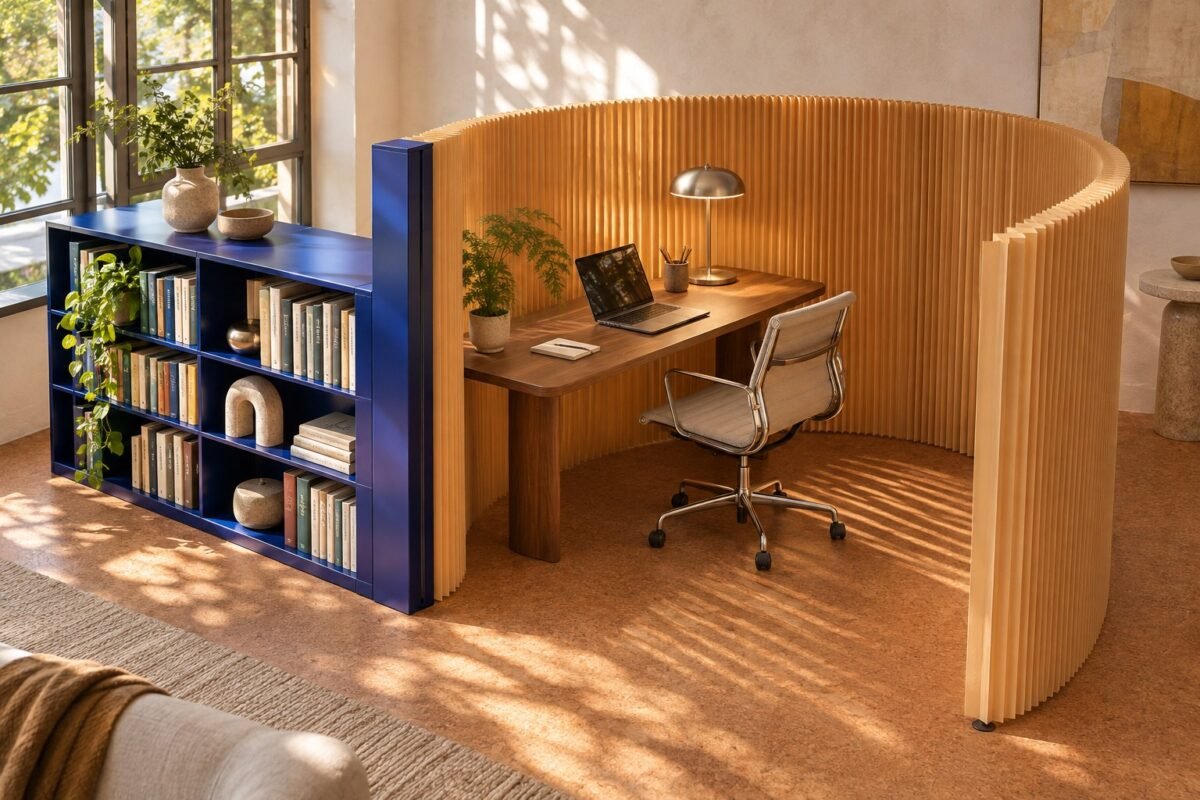
Imagine reaching past the last book on the shelf and taking hold of a narrow blue handle. You walk the handle around your desk. A honeycomb paper wall unfolds behind it, its amber ribs spreading like the pages of a book fanned open. You stop with a wide opening beside your chair. In the laptop preview, the laundry has disappeared behind a clean, softly lit curve. The kitchen is still open for lunch.
This is a speculative furniture concept for a home office that shares a room with the rest of your life. The bookcase would give your desk a temporary room of its own, then take that room back into its side when you’re finished.
A wall that folds into the width of a few books
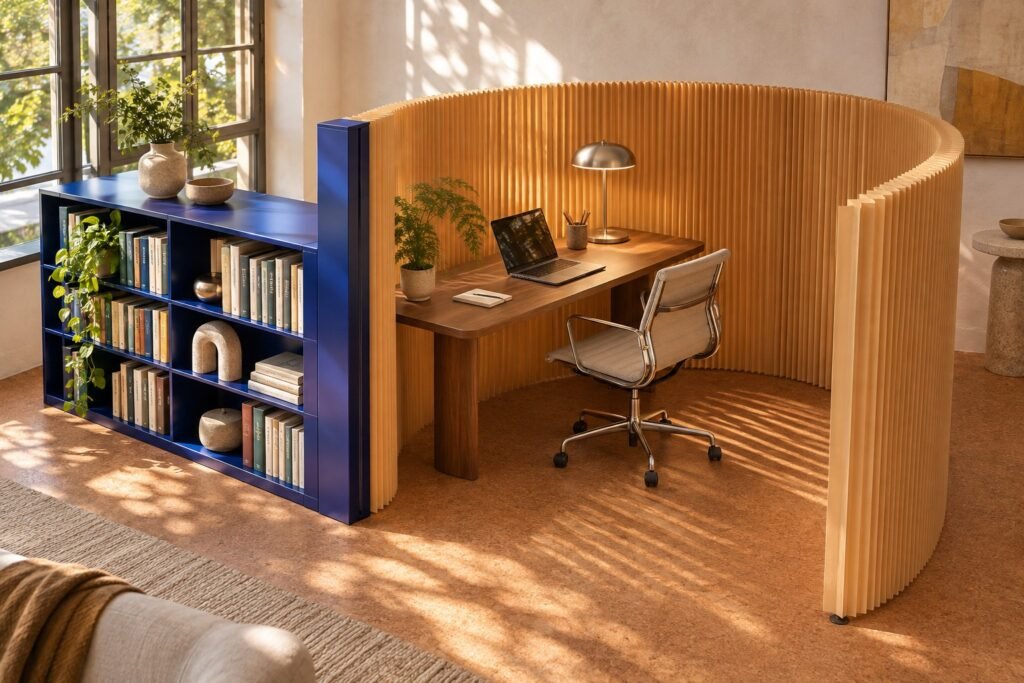
I picture a low cobalt-blue aluminum bookcase with open cubbies. At one end, a taller upright would contain the folded screen, packed vertically inside a removable sleeve. The books would stay exactly where they are during the transformation. The wall would emerge sideways and open into the room, leaving the top of the case free for a lamp or whatever usually lands there.
The material is what makes this more interesting than a folding screen with three rigid panels. Bond thin sheets in an alternating pattern and, when you pull the ends apart, the spaces between the sheets open into cells. Those cells give the panel depth. Stretch one section more than another and you can steer the wall into a curve. The real precedent is Paper Softwall, documented by the Museum of Modern Art, a freestanding honeycomb divider by Stephanie Forsythe and Todd MacAllen.
For this bookcase concept, one end of the panel would stay in the upright. You’d guide the other end by a rigid handle with a wide, rubber-bottomed foot. The foot would rest flat when you set it down, and a concealed catch in the upright would hold the handle once you folded the wall away. There’d be no floor track to cross on the way to your chair. The real work for a furniture maker would be getting the screen to stay put at several useful lengths while keeping it light enough to gather with one hand.
I’d give the screen a replaceable panel and a reinforced lower edge. That edge would face the vacuum, the chair wheels, and the occasional shoe long before anyone worried about wear at the top. The upright and case would also have to be tested together for stability under a sideways pull, with the shelves empty as well as loaded. A real installation would need a secure anchor suited to the wall.
The curve changes who gets to use the room
On a quick call, you might pull the screen just far enough to hide the busiest part of the camera frame. For a longer writing session, you could draw it farther around one side to put the television out of your peripheral vision. Either way, you could leave the other side open toward the window or into the living room. That’s where a flexible wall earns its space. A straight screen gives you a line to work around. This one could bend toward the desk to give the walkway back a few inches.
From my years in furniture retail, I’d judge the idea by what happens on the busiest day in the room. Can somebody reach the sofa while you’re working? Can you roll your chair back and stand without nudging the screen? If the bookcase sits near the doorway, do you have to pack the wall away every time someone comes in with groceries? The first layout I’d try would leave the route from the door to the kitchen clear in both positions and put the opening on the side where you naturally get up.
Light would set another limit. If your window is behind you, a long curve might take the glare out of the picture but also take away the daylight you like. Try moving the screen’s end a little at a time and looking at the desk from the seat. If the useful position leaves your face in shadow, turn the desk or shift a lamp before making the enclosure bigger.
What stays private when the screen is open
A screen can keep an unmade bed out of your camera frame and let someone cross the living room without being seen. Your voice still has a path over the wall and through the opening. The U.S. General Services Administration’s guide to office acoustics explains why a partition can give the impression of a private room while nearby people can still make out what you say. For a sensitive conversation, take the call somewhere with a door you can close.
The material has limits, too. A paper wall would be a poor fit next to a heater or in the splash zone by the kitchen sink. In a room where the screen would get bumped repeatedly, I’d want to test a textile version before committing to paper. I’d also keep the opening wide enough to enter and leave freely, even with the chair pulled out. The pleasure of the idea is being able to give the desk a boundary for twenty minutes and then let the room open up again.
Try a five-minute camera-frame test
Before buying a room divider or moving the bookcase, sit where you usually take calls and open your camera preview. Ask someone to walk the route they normally take through the room, or prop the phone at eye height and record yourself walking it. Mark where the background first gets busy. Place a stable folding screen there if you have one, or drape a sheet over the backs of two sturdy chairs where they can stand clear of the walkway. Leave a gap where you normally enter the desk area.
Check the preview again, then get up and sit back down. See whether your chair clears the barrier and whether you can still reach the lamp or the window. Move the screen closer to the desk in small steps until it covers the part of the frame you care about. You may discover that the whole apartment only needed a little bend in the background.
Further reading
- Museum of Modern Art — Paper Softwall. The collection entry explains how a layered paper honeycomb expands into a freestanding divider and folds down for storage.
- molo — Paper softwall folding partition. The manufacturer shows how its flexible divider can form straight and curved layouts and how the ends connect.
- U.S. General Services Administration — Sound Matters. This illustrated office guide explains how layout, partitions, and sound isolation affect whether nearby people can understand a conversation.