You pinch off two basil leaves for dinner, and the stem comes with them. The pot has spent the week leaning toward the kitchen window. Two feet away, a bright rectangle of afternoon sun lies across the tile. It warms the floor, slips under the edge of the table, and will be gone before the pasta water boils. The basil is on the counter because the window ledge barely holds a salt shaker.
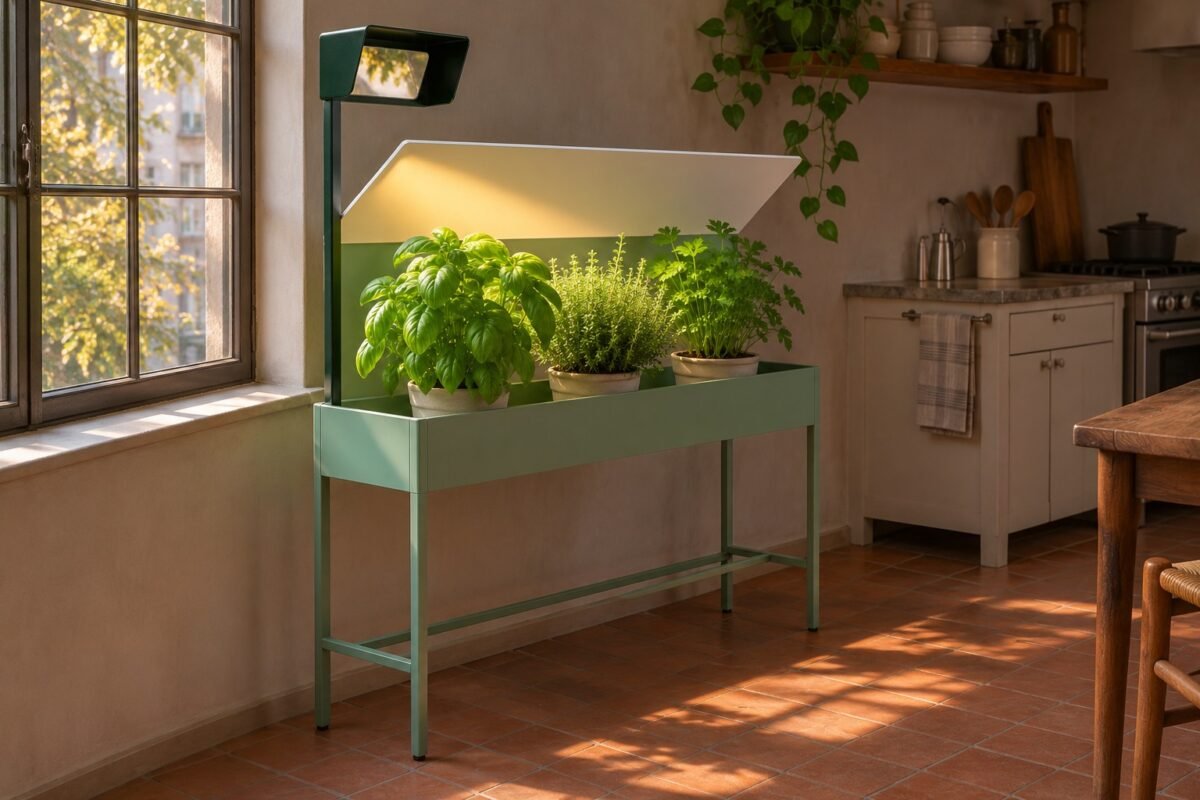
Imagine that the patch of sunlight has a second destination. A small mirror at the top of a sea-green planter console turns almost too slowly to notice. The bright rectangle lands on a white panel above the pots, and a wash of warm light falls onto the leaves. The basil stays where you can reach it with one hand while you stir the sauce with the other.
This is a speculative kitchen furniture concept. A low planter console would use a sun-tracking mirror to redirect a portion of the light that already enters the room. In the right kitchen, it would let the plants and the window keep a little distance between them.
What a Norwegian town square has in common with a basil pot
In Rjukan, Norway, three computer-controlled mirrors on a hillside aim sunlight down into the town square. The installation is called the Sun Mirror, and the local visitor office documents how it brings a patch of light into the shaded valley. It solves an unusual version of the same problem. The place with access to the sun and the place where people want the sun are two different places. VisitRjukan’s Sun Mirror project.
The moving part is called a heliostat. Its mirror changes angle as the sun moves so that the reflection stays on a target. In a solar power plant that target can be a receiver on a tower. In this concept it would be a matte panel just above a row of herb pots. The flat mirror would send daylight toward the panel, which would spread it over a wider area. U.S. Department of Energy’s heliostat overview.
I picture a shallow console made of powder-coated steel, with three removable pots in a tray and a narrow upright on the window side. The upright would carry a small mirror inside a deep hood. I’d start with a kitchen that already gets a clear stretch of direct light and use the console beside that window. Keeping the route from mirror to panel short would leave fewer places for the beam to cross a person or a work surface.
The mirror would have one place to send the light
The mirror would pivot on two axes inside its hood. Once the console was positioned, a controller would adjust the angle as the sunlight moved. A sensor at the receiving panel could help detect whether the reflection was still landing there. A real design would need physical stops that keep the mirror from aiming across the room and a shutter that closes if the console is knocked, turned, or loses power. The aim would be a broad patch on a matte panel from a single flat mirror, with no concentrating lens.
One complication is that a mirror can lose its view of the sun long before the room goes dark. A window frame can cut across the beam. So can the building across the street, a blind lowered to stop glare, or the steam that fogs the window while dinner simmers. The console would stop tracking when it lost direct sun and wait for it to return. A small indicator could show whether the mirror was sending light or parked so that you could tell at a glance how much of the afternoon the plants actually got.
The light would also be uneven. A tall basil plant could cast a shadow over a shorter neighbor. I’d make the tray wide enough to move the pots independently, and I’d make the white panel removable so it could be wiped down. Before anyone could say what grows well there, a prototype would need measurements at leaf height, along with checks for heat and glare from typical seated and standing positions.
The console has to earn its corner of the kitchen
From my years in furniture retail, I’d look at the route from the refrigerator to the sink before deciding how deep the console could be. A hand can reach around a piece of furniture in an empty room. A person carrying a colander full of wet greens needs room to turn. The planter should also be close enough to the sink that you can lift out a pot, water it, and let it drain without trailing water across the floor. I’d keep the electrical parts above and away from the tray and give the tray a lip you can catch with both hands.
There’s a size trade-off. A wider receiving panel could spread the light over more pots, while a shallow console tucked next to a window is easier to live with. I’d start with the herbs you actually cut for dinner. If your kitchen only gets a few scattered minutes of direct sun, a suitable grow light would give you more control over the duration. The University of Minnesota Extension guide explains how both light levels and hours of exposure matter when choosing a location. University of Minnesota Extension’s indoor lighting guide.
Try a daylight map before moving the plants
On a clear day, look at your kitchen in the morning, around midday, and in the late afternoon. At each check, take a photo from the same doorway and note which bright spots reach the height of a plant’s leaves. A patch on the floor can be misleading if a table would put a pot above it. Hold up a white card at the height you’re considering to make it easier to see the edge of the bright area. Repeat on a second day if a tree, neighboring building, or half-closed blind changes the picture.
Compare the places you found with the light needs of one plant you already have. Then try a stable stand in the brightest suitable spot you can still reach for watering. Give yourself room to open the nearest door or drawer before you settle on the location. The best spot may be one you walk past every day, with just enough afternoon light for a pot at the right height.
Further reading
- VisitRjukan — The Sun Mirror. See how three hillside mirrors send sunlight into the town square in Rjukan, Norway.
- U.S. Department of Energy — How heliostats track and reflect sunlight. The department explains how tilting mirrors keep reflected sunlight aimed at a fixed target in solar power systems.
- University of Minnesota Extension — Lighting for indoor plants and starting seeds. This guide explains how light intensity and duration affect plant placement and when artificial lighting can help.