The doorbell rings while you’re moving the spare chair out of the way of the cupboard. You put it beside the sofa, then realize that’s where your guest will need to walk. The chair has spent the week holding a tote bag. Now it finally has a person to hold, and finding a place for it is still the first job of the visit.
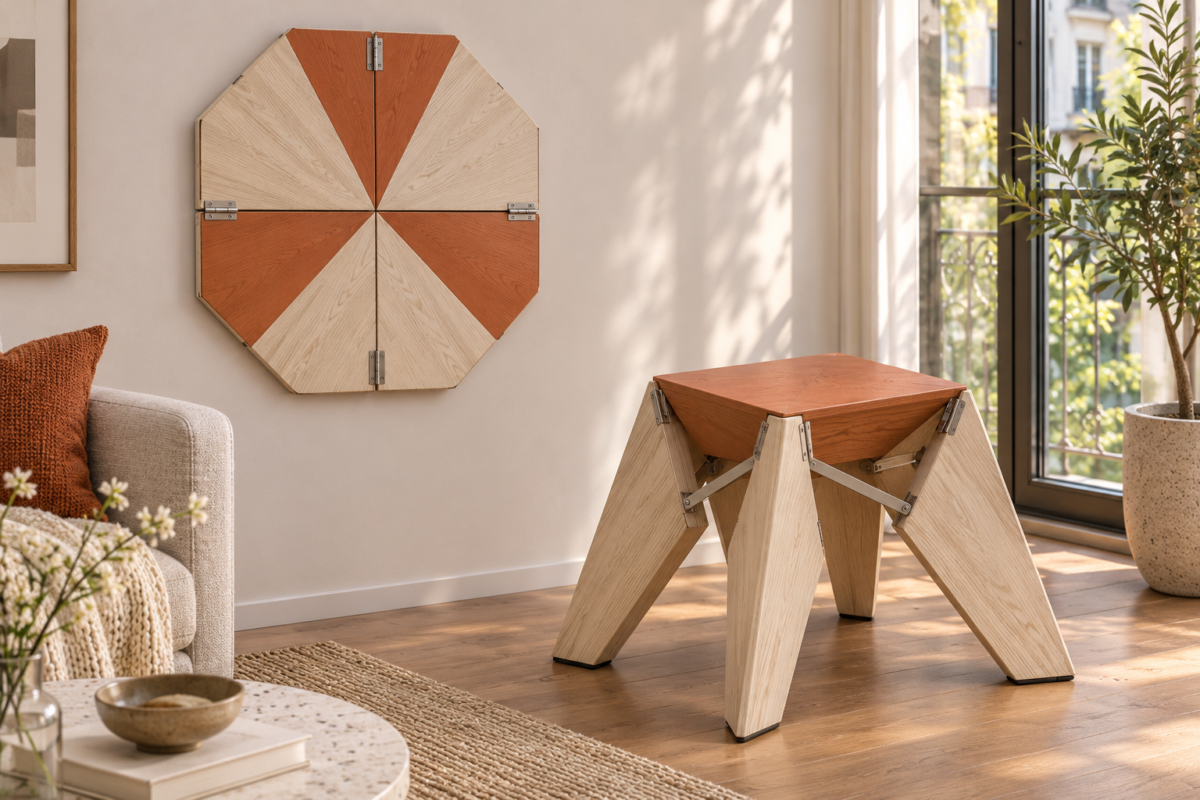
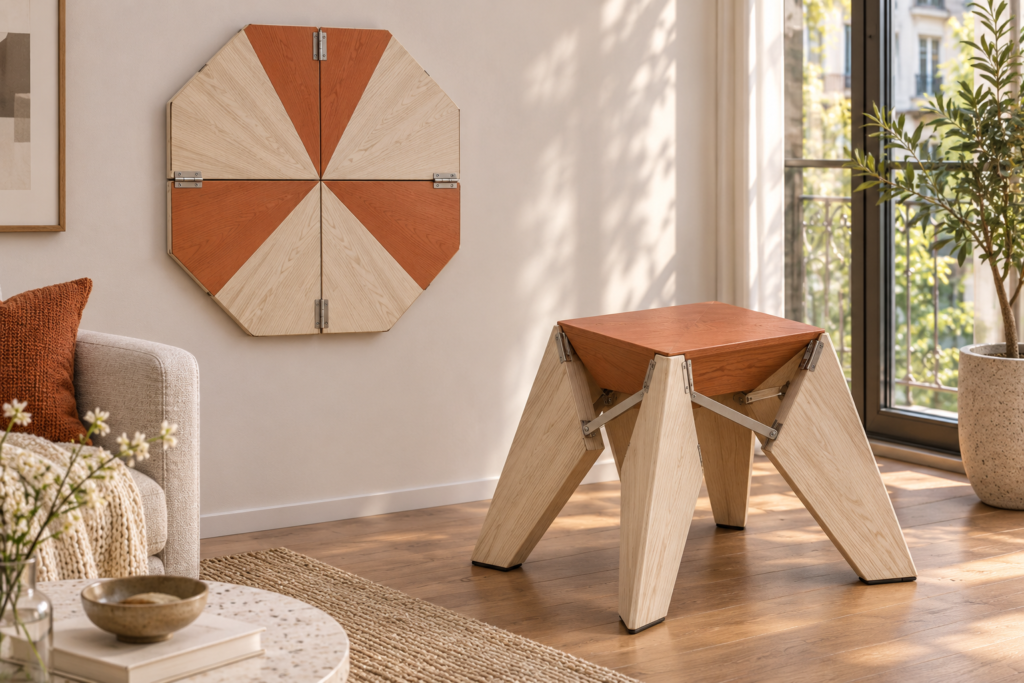
Imagine lifting a geometric panel off two hooks beside the bookcase. You rest its lower edge on the floor and pull the center toward you. Pale wood triangles fold outward, a terracotta square rises into a seat, and four broad supports settle onto the rug. The pattern that hung on the wall has become a stool.
This is a speculative guest seating concept. A folded stool would form a decorative panel between visits, making its stored shape part of the room. When someone needs a seat, the same hinged facets would open into a freestanding structure.
Start with the flat pattern
I picture an octagonal panel made of ash-faced engineered wood, with a terracotta-colored center and lighter triangular sections around it. In the stored position, the parts would lie nearly flat against each other. Small gaps along the fold lines would make the mechanism visible as a geometric pattern. Two recessed hanging points on the back would hold the folded assembly on a suitable wall bracket.
The central square would become the seat. Around it, linked panels would fold into angled supports, with wide contact surfaces at the floor. A person opening it would hold designated grips at the edges, set the supports down, and engage a visible brace before sitting. The hinge pattern would need development through mock-ups. A paper model could explore the movement, followed by structural prototypes in the intended materials.
There are real examples of furniture built around coordinated flat parts. Folditure describes its pyramid hinge as a way of moving planar components together into a rigid three-dimensional frame. Its Leaf chair shows how a dining chair can fold into a flat silhouette. This imagined stool would use its own geometry and locking arrangement to create both the wall pattern and the seat. Folditure’s mechanism explanation and Leaf chair features.
The last movement has to be a lock
The appealing part of the idea is the unfolding. The part that makes it usable would be the final lock. I’d want a brace whose position you can see from above, with a clear indication that it is fully engaged. Opening the stool should be done with nobody sitting on it and with its feet resting on the floor.
A prototype would need testing for loads at the seat edge, sideways movement, and repeated folding. Someone might sit at a corner while reaching for a cup, or shift their weight while turning toward the conversation. The supports, hinges, seat, and brace would need to handle those movements as one assembly. Its load rating would come from that work.
I’d also check what happens if one support is resting on the edge of a rug. Broad feet could help distribute contact, but the geometry would still need to be tested on intended floor surfaces. Replaceable pads under the feet could protect the floor and make worn parts easier to service. The same pads would need to stay clear of the folding path.
A seat with a history, and a different storage job
Portable seating has a long history. The Metropolitan Museum of Art documents a wooden folding stool from ancient Egypt. The object is worth looking at for the simple challenge it represents, carrying a seat and setting it up where it is needed. This concept would add a very particular storage destination, the wall beside your everyday furniture. The Met’s folding stool.
The wall position would influence the whole design. The folded panel should be light enough for the intended user to lift comfortably, with grips that keep fingers away from hinge gaps. A shallow catch could hold the parts together while it is being carried. The bracket would need to suit the complete weight and the wall construction, with clear installation instructions.
I’d hang it where a person can take it down with both hands. Above a sofa, you may have to lean over cushions to reach it. Behind a door, the panel could be hit each time someone enters. A clear stretch of wall beside a bookcase might work better, provided the panel doesn’t project into the walking route.
Does the stool fit the visit?
From my years in furniture retail, I’d start with the person and the length of the visit. A stool can be useful for joining a short conversation or sitting beside a coffee table. Some guests will prefer a chair with a back and arms, especially for a longer stay or when standing up. Plan the main comfortable seats first and decide what role the spare one needs to play.
Seat height matters in relation to the other furniture. Try a stool beside your sofa and see whether conversation feels easy from both places. Check whether your feet find a comfortable position and whether you can rise normally. If you intend to use the spare seat at a dining table, test it at that table with your knees underneath and a plate in front of you.
The deployed footprint would be wider than the seat itself. Angled supports can occupy space where another person expects to put a foot. I’d mark those corners on the floor plan and check the route to the kitchen with someone sitting on the stool. A compact stored shape is only half of the small-space question.
Try the spare-seat storage test
Choose a stool or folding chair you already own. Put it where a guest would actually sit and leave it there while you walk through the room carrying a tray. Open the nearby cupboard, sit in the main chair, and stand up again. Adjust the spare seat until it belongs in the conversation without interrupting the route.
Then measure its folded shape and test a storage location using a cardboard outline. Hold the outline where you could reach it with both hands, keeping it clear of switches and door swings. Consider the weight separately by lifting the actual seat from a safe floor position. You’ll have a useful list for shopping, the occupied footprint, the stored size, and the lift you can comfortably manage.
Further reading
- Folditure — Leaf folding chair. The manufacturer shows how a dining chair folds into a flat silhouette for storage.
- Folditure — Folding mechanism technology. Read how linked planar parts move together into a rigid three-dimensional furniture frame.
- The Metropolitan Museum of Art — Ancient Egyptian folding stool. The collection entry documents an early wooden folding stool, a historical example of portable seating.