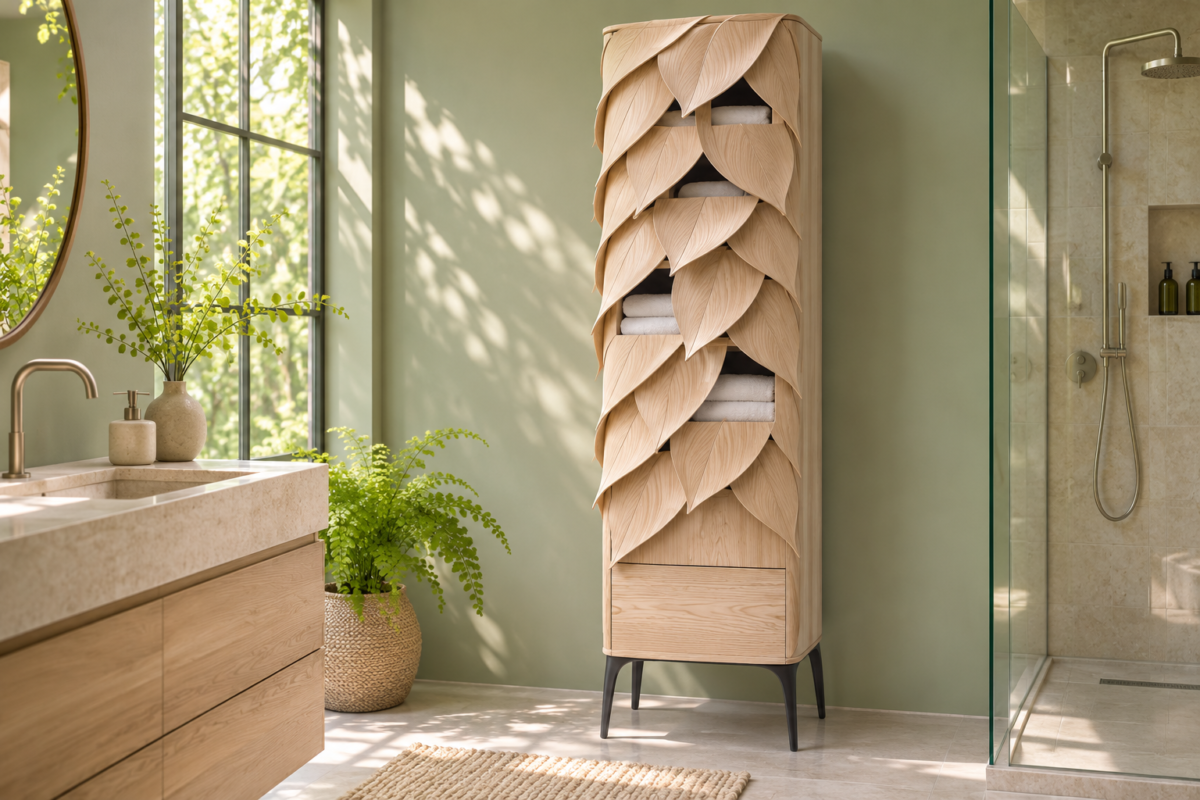
The mirror has cleared, but the bathroom still feels close. You reach for a fresh towel and find the linen cabinet packed tightly, every shelf filled to its front edge. There is nowhere convenient to leave the door ajar without catching it on your sleeve.
Imagine the cabinet responding before you touch a handle. Across its face, thin wooden scales slowly change their curve. Dark gaps appear between overlapping leaves, turning a quiet column of pale timber into something like a pinecone caught mid-bloom. The furniture has changed its own skin.
This is a speculative bathroom linen cabinet concept, not an available product or a tested moisture-control system. Its defining idea is a front made from humidity-responsive wood composites. The proposed scales would change the size of ventilation openings as room conditions change, without relying on a motor to move each leaf.
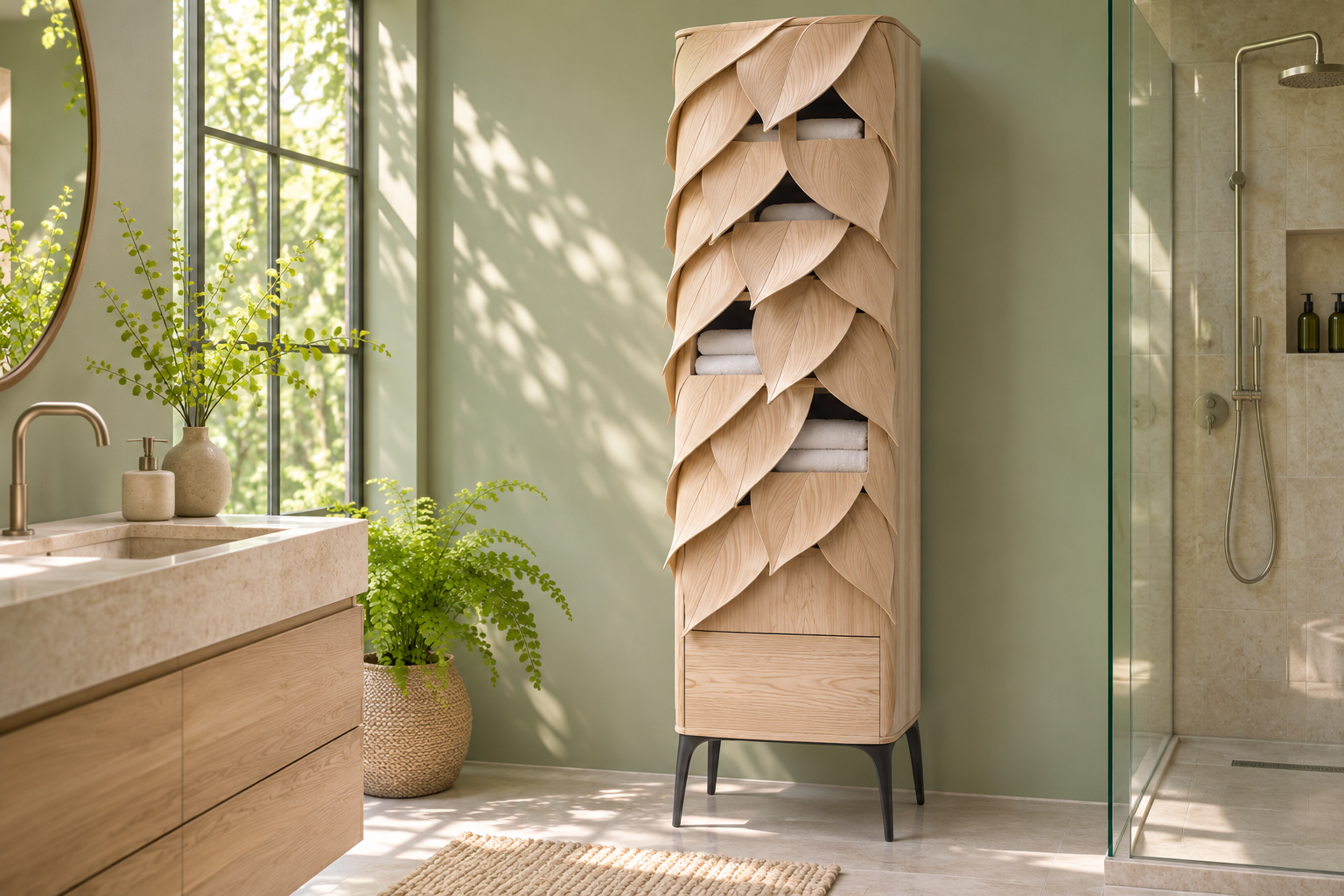
A cabinet with a changing skin
I picture a slim ash-faced frame on charcoal legs, with dry folded towels on ordinary fixed shelves. The responsive scales would sit in removable panels mounted to conventional hinged doors. You would still open a proper door to retrieve a towel. The leaves would handle the smaller, slower change between a more enclosed face and a more open one.
The structural frame and shelves would stay dimensionally controlled through their own construction. Only the designated thin elements would be intended to move. Letting every board in the cabinet swell and twist would produce a maintenance problem rather than an expressive piece of furniture.
Each scale would overlap the one below it with enough clearance to curl without scraping. A dark inner guard would keep towels from pressing against the moving surfaces. The illustration shows the desired appearance, with visible gaps and a pale leaf pattern. It does not establish how far a particular laminate would move in a real bathroom.
The material supplies the movement
The University of Stuttgart’s HygroSkin pavilion demonstrates a real architectural use of moisture-responsive wood composites. Its apertures change openness in response to ambient relative humidity, using the behavior of the material rather than electronic controls. The university’s project explanation describes that research.
For this cabinet, a development team could investigate thin bonded layers with different grain orientations and moisture responses. When the layers change dimension differently, the composite could bend. The layup, thickness, initial curve, and attachment would have to be developed together to obtain the intended direction of movement.
The proposed goal would be wider gaps under more humid conditions and narrower gaps when conditions become drier. That direction is a design requirement for this imagined cabinet, not a claim that the pavilion’s parts can be transferred unchanged. Response time and travel would need measurement across repeated cycles in the intended room environment.
There would be no instant opening sequence timed to the shower. The material might react slowly, and conditions inside a crowded cabinet might differ from those at its front. A useful prototype would need to compare the leaf movement with actual air exchange through the shelves, rather than treating a visible curl as proof of useful ventilation.
Self-shaping furniture is real, but the jobs differ
Stuttgart’s HygroShape project also explores wood that develops a designed curved form as it adjusts to its surroundings. Its furniture components are prepared in flat configurations and use moisture-related shrinkage to shape themselves; mechanical locking contributes stability afterward. See the HygroShape research.
That is a different task from a cabinet front expected to move back and forth over many bathroom cycles. The useful connection is the possibility of designing with material behavior. Neither project validates this linen cabinet, supplies its specifications, or establishes its durability near a shower.
A cabinet prototype would need its own test program for repeated humidity changes, cleaning, edge damage, and bonds between layers. A scale that responds beautifully once could still be unsuitable for years of handling. Replaceable panels would let the design evolve without requiring the owner to discard the frame and shelves.
More openings do not remove moisture
The cabinet would hold dry linens. Wet towels would belong on an appropriate drying arrangement rather than being tucked behind the scales. Opening the front would not dehumidify the room or make damp contents dry on a promised schedule. Its usefulness would depend on the surrounding conditions and the air routes the cabinet actually provides.
I would leave fixed openings at the rear or base as part of the proposed enclosure, so a temporarily closed front does not become a sealed box. Shelf loading would matter too. Towels packed against every wall could block the intended routes even when the scales have opened.
Cleaning raises another trade-off. A coating that changes moisture exchange could also change the response, so the finish would need evaluation with the laminate. The movable front should be kept away from direct spray and standing water. A splash-resistant fixed lower section could protect the most frequently wiped area, while the upper panels remain accessible for careful cleaning.
The decorative edges should be rounded, with stops to limit travel and enough spacing to avoid catching fingers or fabric. This is not a surface to pull on. Large separate handles would make the normal door operation obvious, and the inner guard would protect the leaves when someone pushes a stack of towels onto a shelf.
Measure the cabinet while you use it
From my years in furniture retail, I would begin with the reach and the room around the piece. A tall narrow cabinet may look efficient, yet its upper shelf can become storage for things nobody wants to retrieve. Put daily towels at a height the intended user can comfortably reach and reserve higher space for less frequent items.
The door needs room to open fully without meeting the shower screen, sink, or person standing beside it. The scales would also project farther in their open state. Their maximum envelope belongs in the measurement, even if the movement is slow and only a few leaves are fully extended at once.
A tall cabinet would need an appropriate stability and anchoring design for its installation. The legs should allow cleaning access without making the unit awkward to secure. A real product would need clear installation instructions and an established load capacity; an attractive rendering cannot answer either question.
Try the towel-shelf test today
Take one shelf of linens out of your existing cabinet. Fold only the towels you actually use there and put them back with visible space around the stacks. Check whether the door closes easily and whether you can remove a towel without pulling its neighbors forward.
Then rehearse the morning routine with the door open. Reach for a towel, step back, and check nearby door swings. If the cabinet is awkward, try moving daily items to another shelf before shopping for a replacement. Measure the stack depth and the clear access you need, rather than relying only on the cabinet’s outside dimensions.
Keep damp items out of that storage rehearsal. The practical lesson from the imagined wooden skin is to notice the space around the contents as well as the contents themselves. The future cabinet might curl its leaves in response to the room; today, a less crowded shelf can make the towel you need much easier to find.
Further reading
University of Stuttgart, ICD — HygroSkin: Meteorosensitive Pavilion. Explore the real humidity-responsive wood-composite apertures that inspired the proposed material movement.
University of Stuttgart, ICD — HygroShape: Self-Shaping Wood Furniture. Read how prepared wood components develop curved furniture forms through moisture-related shaping, a different application from repeatedly moving cabinet scales.