The cushion under your knees has escaped again. You pull it back with one heel, shift the pillow behind your shoulders, and lose the comfortable hollow you made ten minutes ago. The attic is quiet, the book is good, and your improvised reading nest seems determined to rearrange itself.
Imagine shaping a broad floor lounger with your hands, making a shallow cradle for your back and a ridge beneath your knees. You step away and press a control. A pump removes air from sealed chambers inside the upholstery, and the loose filling becomes firmer. The landscape you sculpted stays put. Later, opening a valve lets you reshape it for someone else.
This is a speculative furniture concept, not an available product or a tested seating system. Its central transformation is a change in stiffness: a loose, moldable floor cushion becomes a more stable contour through granular jamming. It would not inflate itself into a chair or automatically discover your ideal posture.
A small landscape you can reshape
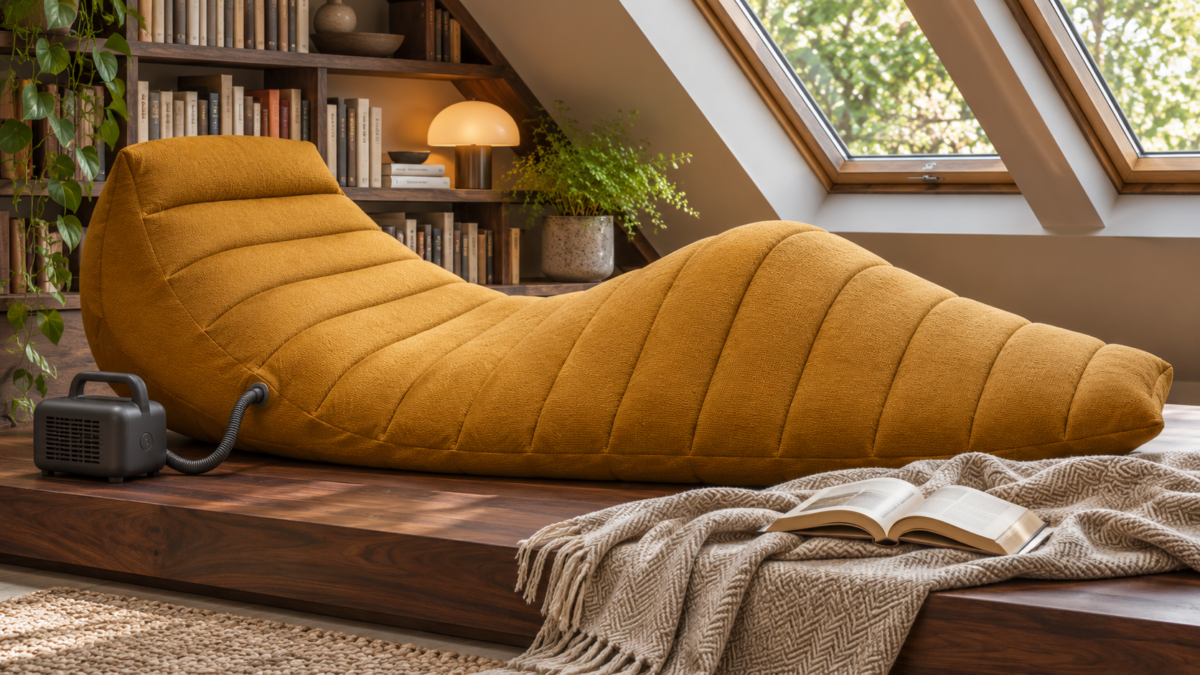
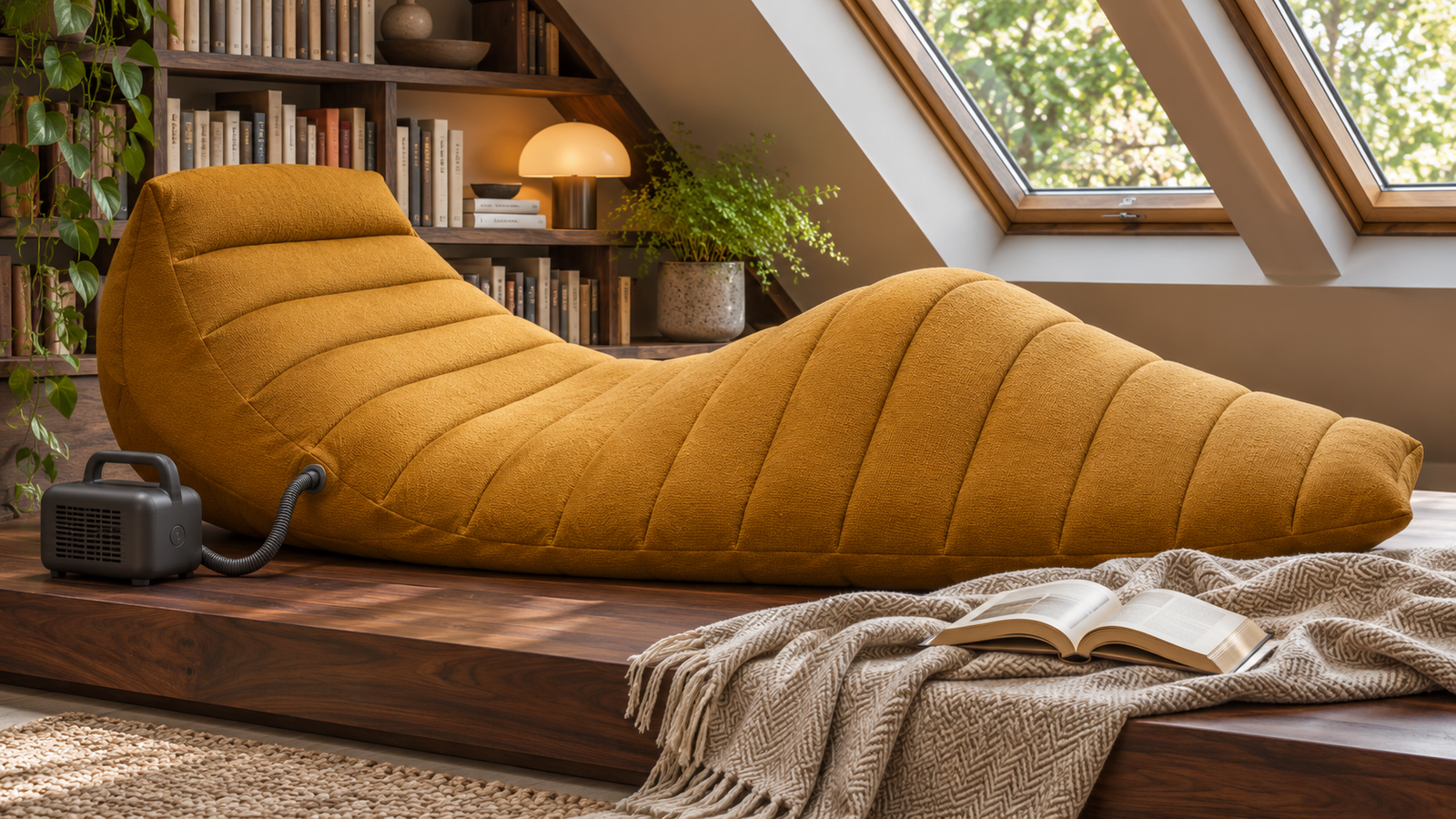
I picture ochre upholstery divided into broad chambers on a low walnut platform. Inside each sealed chamber, dry particles would be free to move when air is admitted. You would redistribute that filling while the lounger is unoccupied, then remove air to make the particles resist movement.
The head end might be shaped into a low slope, with a shallow seat hollow and a separate rise for the knees. Independent chambers could keep all the filling from migrating to one end. Their boundaries would also limit how freely the whole form changes. That compromise would have to be explored with physical models, rather than hidden behind the word adaptable.
A thin comfort layer would sit above the sealed compartments, beneath a removable fabric cover. The surface should not feel like a sack of hard grains once the vacuum is applied. Handles along the sides could help with repositioning, although the filled assembly might still be too heavy for one person to move comfortably.
The real science is in a robotic gripper
Cornell reported a research gripper in 2010 that used ground coffee inside a balloon. The flexible bag conformed to an object; removing air made the filling grip more firmly. Admitting air softened it again. The work involved Cornell, the University of Chicago, and iRobot. Cornell’s explanation describes that real experiment.
The Creative Machines Lab also documents the transition between deformable and jammed granular material in the gripper. These sources establish a mechanism for changing material behavior. They do not establish the comfort, durability, or safety of a person-sized lounger, and neither institution endorses this imagined furniture.
For the concept, a filtered vacuum connection would serve several replaceable sealed compartments. A valve would isolate each compartment after shaping. The pump would ideally run only during adjustment. The filling, membrane, seals, and operating pressure would all need development for this particular use. Coffee grounds belong to the research story; choosing a furniture filling would require separate investigation.
A contour that holds is not automatically comfortable
The attractive promise is repeatability within a session. If the knee ridge stops drifting away, you may spend less time rebuilding your pile of pillows. But a contour can hold the wrong shape just as faithfully as the right one. A hollow that feels pleasant for a minute may feel restrictive once you turn a page or roll sideways.
I would want the proposed surface to allow small movements even in its firmer state. Making every chamber maximally rigid would miss the purpose of a reading seat. A development team could compare different amounts of filling and different chamber layouts, asking how easily someone changes position and how the surface feels after a longer sit.
There would be no basis at this stage for claims about pain relief, spinal alignment, or medical benefits. This is an exploration of furniture that remembers a manually shaped contour. Readers looking for seating support should judge actual products in person where possible and consider their own requirements for sitting down and standing up.
Design for the day a seal leaks
If a chamber loses vacuum, its shape would gradually become less dependable. The low platform would remain beneath the whole cushion, but a raised back slope could soften while someone leans on it. A prototype would need deliberate leak tests and a way to limit an unexpected backward movement, perhaps through a separate low structural support.
That support would reduce some of the sculptural freedom. It might also be the feature that makes the idea practical. A permanent boundary behind the head end could prevent the concept from relying entirely on a flexible membrane. The illustration shows the desired reading landscape, not a proven load path.
Repeated bending, grit at the valve, and abrasion between particles and membrane would deserve attention. The chambers should be removable without cutting apart the upholstery. A replaceable liner, accessible connections, and an outer cover that can be cleaned separately would matter more to ownership than a dramatic first demonstration. Any load rating would have to follow testing of the complete assembly.
The floor is part of the furniture decision
From my years in furniture retail, I would start with the movement required to use the piece. A low lounger may suit a quiet attic nook, yet it asks you to lower yourself close to the floor and get back up. That could rule it out for someone who prefers a taller seat with firm arms.
The platform also occupies real space even when the cushion is reshaped. It would need a clear approach, edges you can see, and a location away from a doorway. A sloping ceiling can make a nook inviting while limiting where you can stand. Test the standing space as carefully as the reclining space.
Pump placement would need thought too. A hose across the route to a bookcase would be an irritation, and frequent pump noise would interrupt the very activity the lounger serves. I would place the connection at the rear, keep the equipment accessible for service, and investigate whether the shape could hold for a useful session with the pump switched off.
Try the contour test with what you own
Use a stable seat or floor setup you already find easy to enter and leave. Arrange ordinary cushions for reading, then notice which one you keep moving. Is it behind your shoulders, under your knees, or beneath the elbow holding the book? Write down the movement you are trying to prevent before shopping for another cushion.
Read for a short session and deliberately change position several times. Remove one cushion and see whether the arrangement becomes easier to use. Then check where the book, light, and cup belong. Sometimes the restless cushion is compensating for a book held too low or a side table placed beyond reach.
Measure the useful arrangement, including the space you need to stand. That gives you a concrete brief for choosing a chaise, floor cushion, or reading chair today. The imagined granular lounger turns upholstery into a changeable landscape, but the worthwhile question is wonderfully ordinary: what needs to stay in place so you can settle into the next chapter?
Further reading
Cornell Chronicle — How a coffee-filled balloon became a robotic gripper. Read the university’s explanation of the real vacuum-driven jamming experiment.
Creative Machines Lab, Columbia University — Jamming gripper research. The research page explains the change from deformable particles to a more rigid mass and links the original publication; it does not validate this seating concept.