The washer plays its little tune just as you clear the last breakfast plate. You lift out the shirts, shake one open, and look around. The drying rack is behind the vacuum. The vacuum is behind a folding chair. By the time everything is unfolded, the kitchen door can only open halfway, and your first shirt is draped over the back of a dining chair.
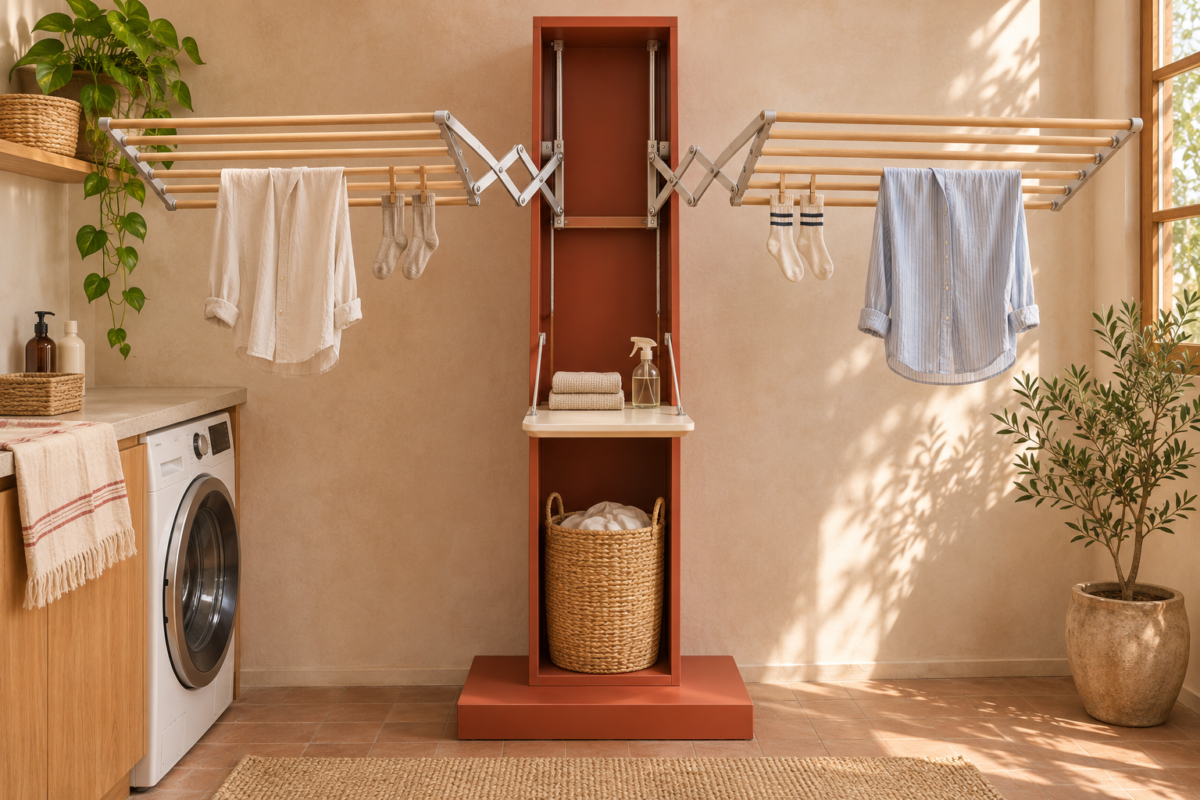
Imagine pulling two handles on the sides of a narrow terracotta cabinet. Silver linkages unfold like the branches of a mechanical tree, carrying a set of drying rails out into the room. The basket stays below, the shirts go above, and you can choose how far each branch opens. When the clothes are dry, the rails gather back against the cabinet.
This is a speculative laundry furniture concept. A slim storage tower would become an open drying structure, giving a load of washing a temporary home while making the setup and packing away part of the same movement.
Let the clothes set the shape of the tree
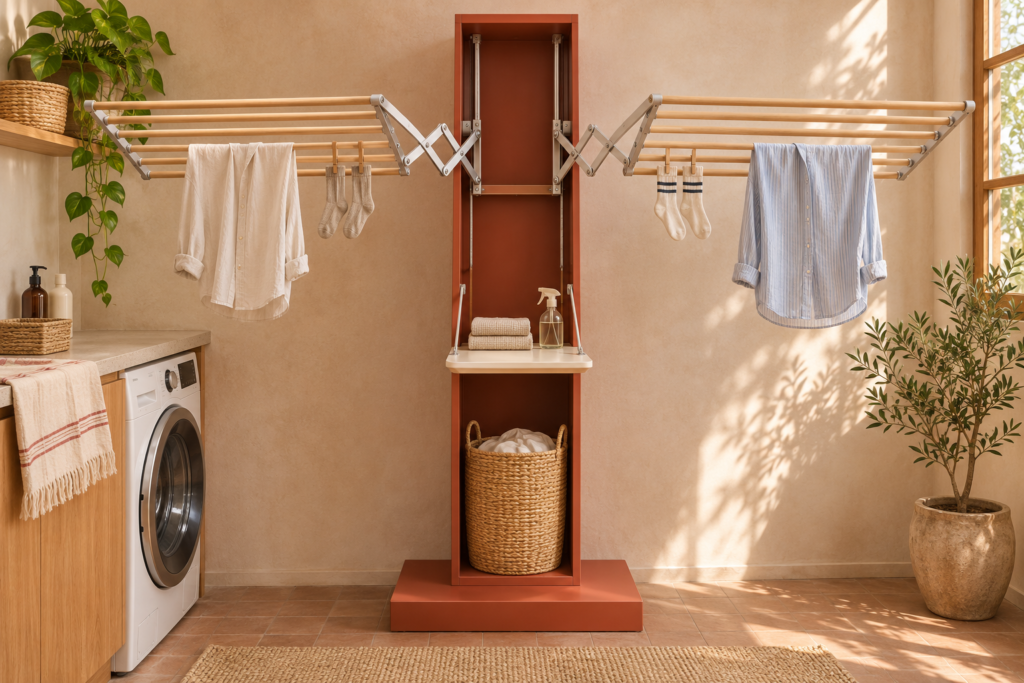
I picture a steel cabinet with an open basket niche below and two folding branches at shoulder height. Each branch would use paired scissor linkages to keep several parallel rails spaced as they travel outward. The rails would stay horizontal, with rounded surfaces where fabric rests. At rest, they would cluster close to the cabinet sides behind shallow covers.
The first version would hold a modest everyday load. Shirts could hang across the rails, with small items clipped below a separate rail nearer the center. Long garments would need a higher hanging point or another place to dry. I’d measure the actual shirts you wash, including how far they hang when folded over a rail, before setting the height of the branch.
Drying rods that disappear into a small housing are already a familiar idea. Leifheit’s Telegant wall dryer extends its rods from a compact wall unit. The imagined tree would bring that expansion into a cabinet with its own supporting structure and branches on two sides. The scissor links would control spacing between the rods while the covers would give them a place to park. Leifheit’s Telegant wall dryer.
A branch needs a stop before it gets a shirt
The branches would move while empty. You would pull a handle until the linkage reached one of its defined positions, then check that the latch had engaged before loading the rails. Each branch could stop at a shallow extension for a few small items or open farther for wider garments. A release under the handle would let the branch return once the clothes were removed.
A fixed broad base would support the cabinet, and the design would need an approved anchoring arrangement where required. A real prototype would have to be tested with wet laundry concentrated on one end of a single branch. Loading both sides evenly may be the everyday intention, but the furniture must also deal with the moment when only one side is loaded. The load rating would need to be established for the complete cabinet and each extension position.
I’d guard the crossing joints and keep the operating handle beyond them. Scissor links have moving gaps, so their position relative to the user would shape the design. The covers could guide a hand toward the handle and keep a loose sleeve out of the mechanism. Service access would be important too. A worn latch should be replaceable without taking apart the entire cabinet.
Air needs a route through the laundry
The open branches would let you spread garments rather than pile them together. I’d make the rail spacing easy to judge at a glance so you can see when two damp shirts are touching. A folding rack such as Brabantia’s HangOn shows how different wing positions can accommodate different items. That flexibility is worth considering before you buy storage that assumes every load looks the same. Brabantia’s HangOn rack.
The tower would have no claim to a particular drying time. Fabric, room conditions, and how you load it would all need to be considered. Before choosing its location, check how the room handles moisture. The EPA’s home moisture guide recommends controlling indoor humidity and explains the role of ventilation and dehumidification. If condensation builds on the window whenever you dry laundry, take that into account when planning the space. EPA’s moisture guidance.
I’d keep the clothes exposed to room air while they dry and put them away only when dry. The cabinet would store the folded mechanism, basket, and clips. A removable tray below could catch occasional drips during loading and lift out for wiping. The tray would need attention after use so standing water doesn’t become part of the furniture.
The room needs to work with the branches open
From my years in furniture retail, I’d measure the piece at its busiest moment. Here that means a loaded drying tree, a basket on the floor, and somebody opening the washer. Mark the far end of each branch and the line where shirts will hang. Then walk from the doorway to the sink with a basket in your hands.
One useful position might be a utility room corner where one branch can open fully and the other only a little. Another room might work better with the cabinet centered on a clear wall. Check the direction of appliance doors and the space you need to lift a wet load. If the cabinet makes you carry laundry around an open branch before you can reach the basket, the arrangement needs another try.
The closed size would matter when cleaning. I’d leave enough access to wipe behind the tower or specify how it can be moved safely after the branches are secured. Check whether the rail ends catch a cloth, whether water can collect inside a cover, and whether the basket slides out without hitting the door trim.
Try the one-load test today
Take the next load you plan to air dry and count its largest items before washing. Set up your current rack and arrange the dry garments with room between them. Measure the space occupied by the hanging fabric as well as the legs. That is the footprint to use when comparing a new rack or cabinet.
Leave it in position long enough to open the nearby doors, reach the washer, and walk through with a basket. You may find that a smaller load fits much more comfortably in two short sessions. Or you may discover a clear strip of wall where the rails could stay ready. Either way, the next drying setup will start with the clothes and the room you actually use.
Further reading
- Leifheit — Telegant 81 Protect Plus wall dryer. The manufacturer shows how drying rods extend from a compact wall housing.
- Brabantia — HangOn drying rack. See how an existing folding rack accommodates laundry with adjustable wings.
- U.S. Environmental Protection Agency — A brief guide to mold, moisture, and your home. This guide explains indoor moisture control, ventilation, and humidity management.