The recipe says to whisk the dressing in a small bowl. You open the cupboard, lift out the big bowl, move the salad spinner, and find the little one underneath. The whisk is across the kitchen. By the time you bring it back, the recipe page has disappeared beneath a chopping board and a packet of herbs.
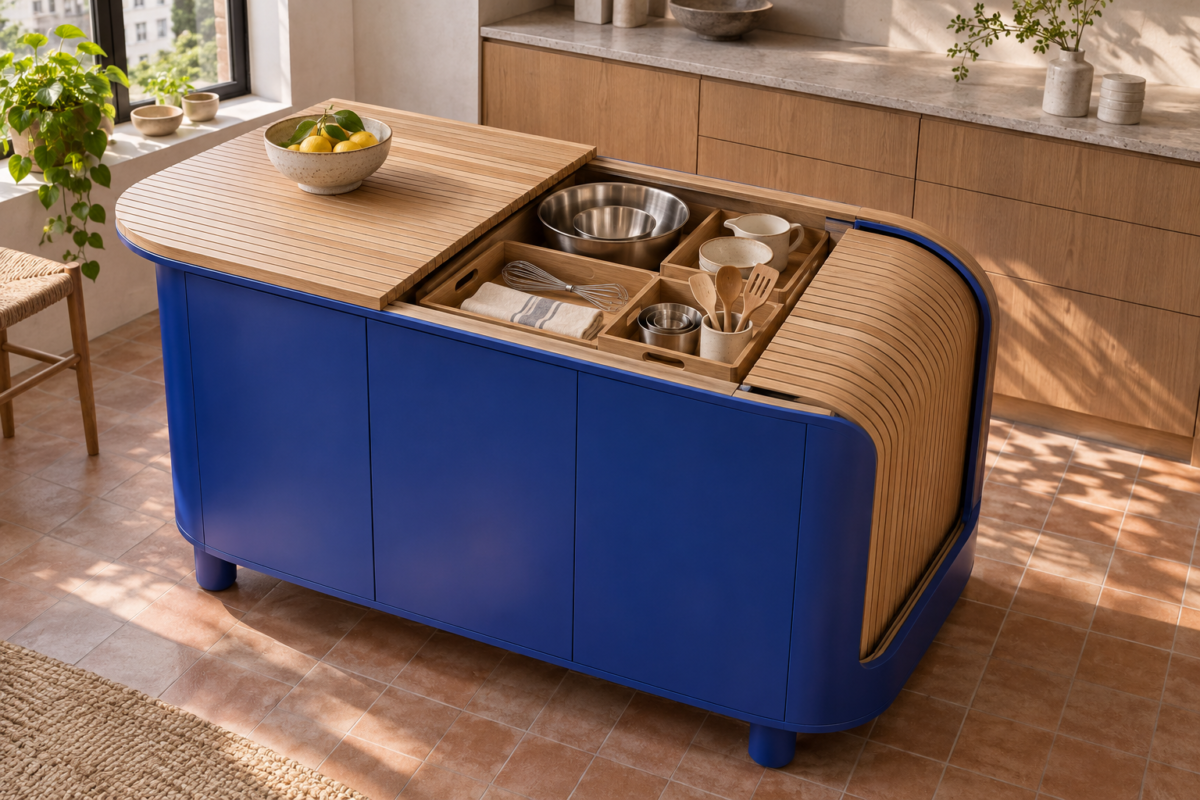
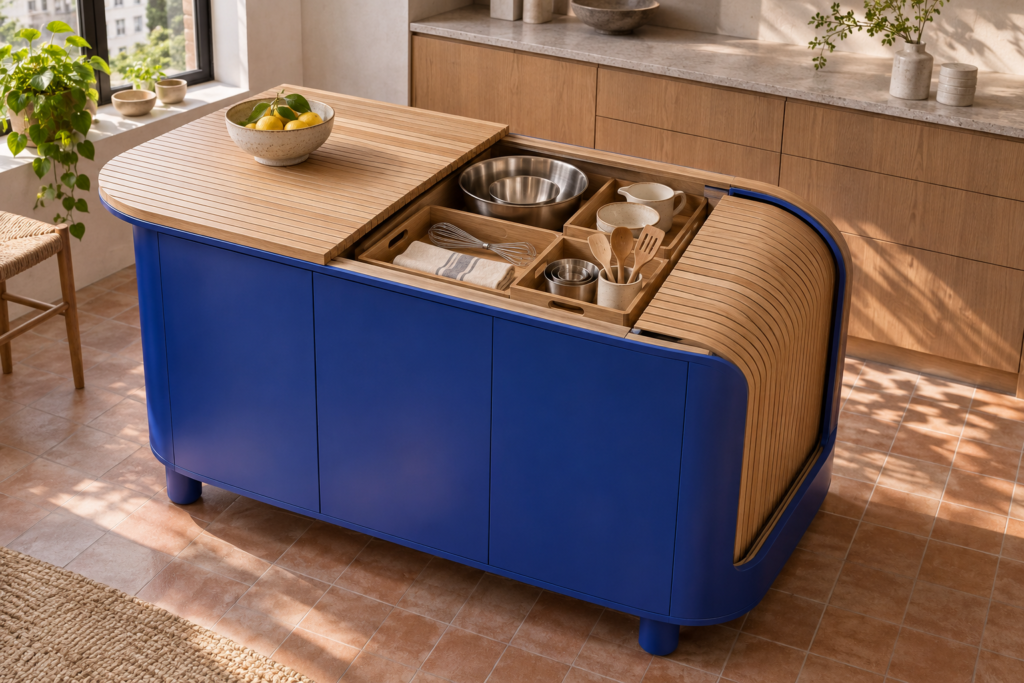
Imagine pushing the edge of the island’s worktop with your palm. The pale oak surface begins to bend around the far end of the cabinet. Slat by slat, it rolls down into the side, revealing a shallow well with your bowl, whisk, measuring spoons, and a clean tray. You lift out the kit, close the top, and start cooking.
This is a speculative kitchen island concept. Its whole worktop would act like a large tambour shutter, giving you access to a preparation kit directly from above. The interesting part would be the sequence of opening, collecting, and closing before the cooking begins.
A surface that can go around a corner
I picture a compact cobalt-blue cabinet with rounded ends and a top made of narrow oak-faced slats. Each slat would be stiff across the width of the island. A flexible backing or articulated connection would let neighboring slats change angle as they follow curved guides at one end. Below the flat section, supports along the cabinet would carry the top when it was closed.
The geometry comes from tambour doors, which use connected strips that travel in guides. Häfele’s custom tambour drawings show how a shutter and its guide profiles occupy space within a cabinet. Making that construction into a horizontal worktop would require a different design for support, sealing, and cleaning. A maker would need to develop those details for the actual span and intended load. Häfele’s tambour drawings.
At the curved end, the top would travel into a guarded pocket down the cabinet side. That pocket would reduce the space available for storage. I’d make it accessible for servicing and cleaning rather than burying the moving surface behind a permanent panel. You should be able to see where a lost teaspoon has gone.
Choose the kit before drawing the cabinet
The well beneath the top would be shallow enough that you could see everything without leaning inside. I’d use removable trays sized around one task. A baking kit might hold scales, measuring spoons, and a bowl. A salad kit might keep a small bowl, whisk, and serving spoons together. The rest of the island could hold deeper items behind ordinary doors.
Easy visibility is already a useful goal in cabinet hardware. Blum’s SPACE TOWER uses full-extension inner drawers to bring pantry contents into view from above and from the sides. Here, access from above would arrive through the opening worktop. The comparison suggests a useful question for the concept. Does rolling back the surface save enough searching to justify clearing it first? Blum’s SPACE TOWER overview.
I’d answer that with the kit itself. If you only need a spoon, opening the whole island would feel excessive. If the tray contains everything for the task you repeat most evenings, collecting it in one movement could be pleasant. The tray would then sit on the closed top beside a separate cutting board. Used tools would go to the sink, and the clean kit would return once it was dry.
The island has to close before it becomes a counter
A moving worktop asks you to keep its travel path clear. A mug left near the curved end could become a mess as the slats start to descend. I’d give the top a broad handle and controlled resistance, with a latch at the fully closed position. The mechanism should be operated only after loose items have been removed from the moving surface.
The top would also need a clear load specification. Chopping, leaning against an edge, and setting down a heavy mixer create different demands. A prototype would need tests across the joints and at the middle of the span, along with repeated opening cycles after normal cleaning. A flat surface that develops a ridge at each slat would quickly become annoying under a cutting board.
I’d keep direct food preparation on a removable board. The slat joints and guides would need their own cleaning instructions, and spills would need a route that keeps them out of the storage well. A removable liner in the well could help with occasional debris. The difficult detail would be sealing enough of the moving assembly to make daily wiping straightforward while preserving the curve that lets it disappear.
Measure the person standing beside it
From my years in furniture retail, I’d place the island in the room with someone using it. Mark the closed footprint first, then stand at the long side with a tray in your hands. Can another person reach the refrigerator? Can the dishwasher door open without trapping you between it and the island? A small cabinet can interrupt the busiest route in a kitchen even when it looks perfectly scaled in a photograph.
The rolling top would save you from storing a loose lid, but the rounded return would still occupy one end. That end would need access for cleaning and repairs. I’d also check whether you can lift a loaded tray straight up without hitting a shelf above, and whether the handle is at a comfortable reach. The mechanism should fit the way you collect things before it determines where you stand.
For a real purchase, take the width and depth of the biggest tray you use along with the island dimensions. Ask for usable storage dimensions and compare the closed top with the work surface you already need. If a conventional island with a full-extension drawer gives you the same kit in one move, try that sequence too.
Try a preparation tray tonight
Choose one meal you make regularly. Before you start, put the small tools for it in a shallow tray. Keep the tray within reach of the work area and leave a clear surface beside it. Cook as usual and notice which items you take from the tray, what you still have to fetch, and where the used tools end up.
After washing up, return only the things you used. Try the same tray for a few meals and measure it once the contents settle. You may find that the useful preparation kit is much smaller than you expected. That measurement gives you something concrete to look for in the next drawer, cabinet, or island.
Further reading
- Häfele — Custom aluminum tambour unit drawings. These drawings show how tambour shutters and guide profiles fit inside a cabinet.
- Blum — SPACE TOWER pantry storage. See how full-extension storage provides visibility and access to pantry contents from several sides.