You settle against the pillows with a book, switch on the bedside lamp, and find its reflection shining from the polished panel behind you. Lean left and it moves. Lean right and the light catches another strip of wood. The headboard looked beautiful in daylight. At night, you wish you could give the whole wall a softer face.
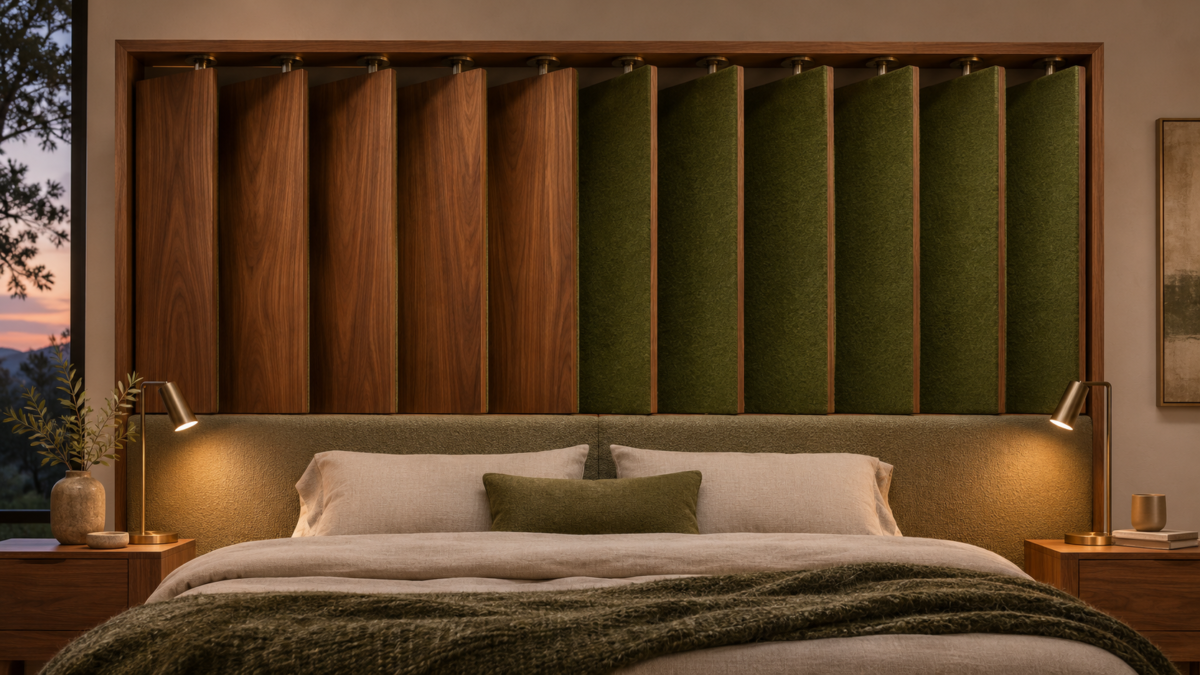
Imagine reaching for a small handle beside the mattress. Above the pillows, a row of broad walnut fins begins to turn. Each one rolls a moss-green felt face toward the bed. The grain disappears a section at a time, and the wall becomes a band of textured green. You leave the other half showing wood, where the lamp is off.
This is a speculative headboard concept. Two groups of rotating fins would let each side of the bed choose between a wood face and a fabric face. The transformation would happen inside a fixed frame above a stationary upholstered cushion, where you actually lean.
A wall made of reversible fins
I picture a long walnut frame mounted behind the bed, with a row of vertical fins held on top and bottom pivots. Each fin would have veneer on one broad face and a padded felt covering on the other. A slim core would keep the panel straight. The edges would be rounded, and small clearances would leave room for each fin to turn without rubbing its neighbor.
The fins would rotate together in two groups. A concealed linkage in the top rail could connect each group to its own side handle. The linkage would hold the fins at a few defined positions, including wood forward and felt forward. At an intermediate angle you would see both materials as alternating bands, with narrow dark gaps behind them. I’d want to try that position in a full-sized mock-up before choosing the spacing.
The fixed lower cushion would keep pillows and shoulders away from the mechanism. Its height would come from the actual mattress and the position you use for reading. A tall mattress can hide a surprisingly large part of a headboard. Before drawing the moving section, I’d put the pillows in place and mark where a seated person’s head reaches.
The turn needs to feel ordinary
A wall of fins could look theatrical and still be irritating to operate. I’d start with a short handle travel and a positive stop at each end. The fins should turn slowly enough that you can follow their movement, with the force limited if something obstructs them. A prototype would need checks for fingers, hair, and bedding near every moving gap.
I’d keep the controls outside the pillow area and give the linkage a removable service cover above. That puts routine use where you can reach it and maintenance where it can be accessed without stripping the whole bed. The pivots would need to stay quiet after repeated use. A click that sounds neat in a workshop could be unwelcome beside someone trying to sleep.
The frame would need a mounting system suited to the wall and the complete weight of the assembly. The fins would be captured in their pivots so they could not lift out during normal use. For installation, a maker would need to specify the fixings, clearances, and access for checking them. The attractive motion comes with a responsibility to make the structure behind it understandable.
What changing the material could change
The immediate change would be visible and tactile. Felt would give the reading area a different color and surface texture. Walnut would bring back the grain and catch the room’s light differently. The amount of glare would depend on the actual finish, lamp position, and viewing angle. I’d test samples beside the lamp before choosing the finish for either face.
Sound absorption would need separate evidence. WoodUpp’s Akupanel data shows measurements for a particular wood-and-felt panel with specified installation details. It is a useful reminder to ask what construction was tested, how it was mounted, and what frequencies the results cover. Those results would describe that product and setup. A rotating headboard would need its own testing in each intended position. WoodUpp’s absorption report.
Rockfon’s acoustic guidance distinguishes absorption within a room from insulation between spaces. The headboard’s felt face would be an idea to investigate for local sound absorption, with no promised reduction in traffic or neighbor noise. Its size, thickness, backing, gaps, and position would all have to be considered. I’d choose it first for the surface change you can see and use every evening. Rockfon’s acoustic explanations.
The space behind the pillows still matters
From my years in furniture retail, I’d check the extra depth before deciding how wide the headboard should be. The frame and rotating fins would bring the mattress farther into the room than a flat panel. Measure what that does to the route at the foot of the bed, the nearest dresser drawer, and the bedroom door. A few inches behind the pillows can become the difference between walking straight through and turning sideways.
I’d also look at the outlets. A plug and its cable need room behind or beside the frame, with access when you need to unplug the lamp. The linkage should have a separate path from electrical cords. Moving the lamp to a small bedside table could make the headboard easier to service, but the table itself still needs somewhere to stand.
Cleaning would be part of the design. The felt covers should come off through a documented method, and the wood faces should be reachable without putting fingers into the pivots. Ask about the exact fabric and its care instructions. A spare cover or replaceable fin would matter more to ownership than a hidden extra control.
Try the bedside sample test
Place a wood finish sample and a fabric sample safely beside your usual reading position. Use the lamp at night and sit against the pillows as you normally do. Move the samples through the angles you expect the headboard faces to occupy. Notice the reflected light, color, and texture from the bed, then look from the doorway in daylight.
Finally, mark the proposed headboard depth with tape on the floor and shift the bed outline forward by that amount. Walk the room and open the drawers. The samples tell you which surface you want behind you. The floor test tells you whether the room can give it the space.
Further reading
- WoodUpp — Akupanel sound absorption test data. The test report shows how a particular slat-and-felt panel performs with specified mounting arrangements.
- Rockfon — Sound absorption and insulation explained. The catalogue explains the difference between sound behavior within a room and transmission between rooms.