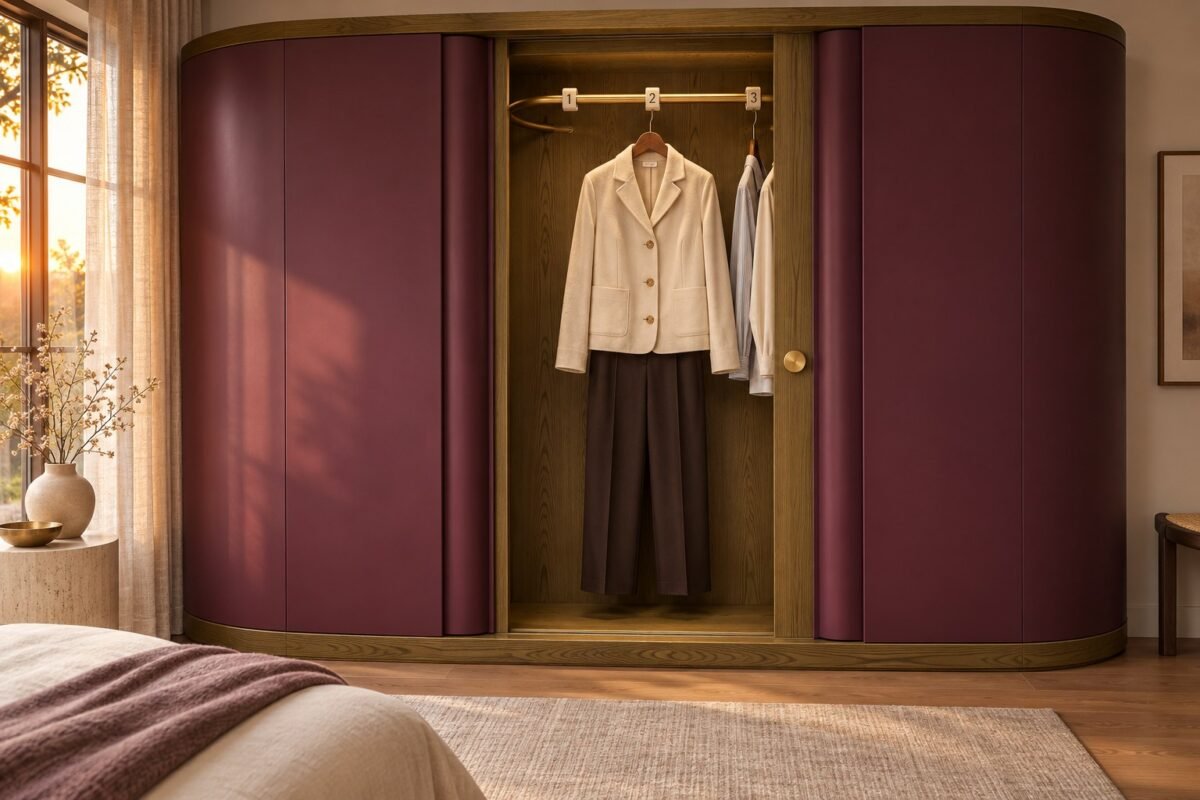
The bedroom is still dark when you find the jacket you want. The hanger comes out sideways, taking two shirts and a scarf with it. The trousers that go with it are somewhere beyond the coats, and the person still asleep on the other side of the room has just turned over. Now you’re pulling things out by the light from the hallway and trying to remember what you wore with the jacket last Tuesday.
Imagine opening one narrow panel in the middle of the wardrobe. You turn a brass dial, and the clothes begin to travel. A raincoat rounds the corner. A blue shirt passes in front of you. Then the jacket arrives with its trousers clipped to the same carrier. The whole outfit stops in the opening under a small light. You lift it off with one hand and close the panel.
This is a speculative furniture concept for a small bedroom. The wardrobe would set an entire outfit in front of you the way a dry cleaner’s conveyor brings a garment to the counter. Its best trick would happen the evening before, when you put a few outfits in order and know where they’ll be in the morning.
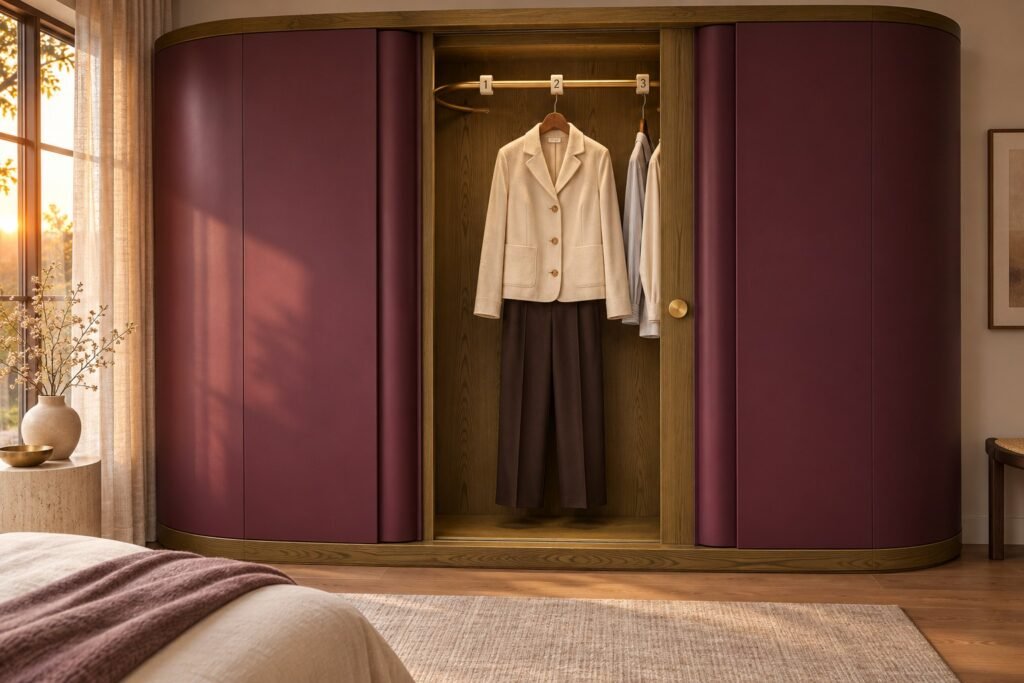
An oval track behind a narrow opening
I picture a plum-colored cabinet with rounded sides and a single opening framed in olive ash. From the outside it might look like an old radio made large enough to stand in. Inside, a shallow oval track above the hangers would carry garments past the central bay. The long runs of the oval would hold most of the clothes. At each end the carriers would round a curve and turn to follow the rail.
Each carrier would hold one outfit or one bulky garment. A jacket and trousers might ride together on a paired hanger, while a winter coat could take the width of two positions. A full-length opening would let you lift an outfit free without drawing the hem through a slot. Behind the opening, a fixed guard above the rail would keep fingers and loose fabric away from the moving parts.
The idea borrows from two real systems. A commercial dry-cleaning conveyor from White Conveyors indexes hanging garments into slots for pickup. A Kardex warehouse carousel brings storage carriers around a vertical loop to an access point. A bedroom wardrobe would turn its track horizontally so clothes could stay on hangers at one height. The useful principle in both examples is that the contents come to a fixed opening. White Conveyors’ garment pickup system and Kardex’s carousel explanation.
Give the week an order you can change
I’d design the dial to step the wardrobe forward or backward by one position. Beneath it, a small indicator would show the number of the carrier at the opening. You could clip a reusable day tag to a carrier, or leave the numbers alone and arrange three outfits in the order you usually get dressed. On Sunday night, load Monday through Wednesday. When it rains on Tuesday, come back one position or go forward to whatever works with your raincoat.
A low-speed drive could move the loop with the access panel shut. The motor would stop and hold still before the panel released. The handle and numbered position would stay readable if the room were dim. If the motor failed, I’d want a manual release for the closed mechanism and separate service access to retrieve the clothes with the drive disconnected. That would take some care to design. The cupboard still has to get you dressed on the morning it needs a repair.
The moving track would also need room around it. A sleeve can swing into the next outfit as it rounds a bend. A dangling belt can snag, and a heavy coat can make a lightly loaded hanger swing as the track stops. A prototype would need repeated trials with uneven loads and actual garments. I’d start with lightweight outfits on the moving rail and put long coats, scarves, and folded knits in fixed compartments where they can stay put.
The right cabinet might hold fewer hangers
From my years in furniture retail, I’d start with how you move around the bed while the wardrobe is open. Can you set a laundry basket down and still reach the opening? Can you turn with the clothes on a hanger without catching the hem underfoot? Doors that slide into the cabinet sides could leave the aisle clear, but their pockets would take some of the width you might otherwise use for storage.
Capacity would be the other trade-off. The return run needs enough depth for the hangers to pass, and the curve uses some of the space where a straight rail could hold another jacket. I’d reserve the carousel for things you wear constantly. In a narrow room where the cabinet must be shallower than ordinary hangers allow, I’d keep the wardrobe you have. Nothing about the moving rail changes how much room a sleeve needs.
Sound belongs on the list, too. A little click seems harmless in daylight. At six in the morning it can be the loudest thing in the room. I’d listen for the mechanism under full and partial loads and make sure the cabinet could stand securely without rattling against the wall. The sound of the door closing matters just as much as the sound of the track.
Try the three-outfit test this week
Choose three outfits from clothes you already wear. Put each jacket or top next to its trousers or skirt on your existing rail. If an accessory tends to go missing, place it in a nearby tray while you’re still getting things ready. Move the three groups to the first place your hand reaches when you open the closet, and leave a finger-width gap between groups.
Use that arrangement for three mornings. Notice which outfit you reach for first, what you swap, and whether you ever have to search the back of the closet. By the third morning you’ll know whether you’d actually use a wardrobe that moves your clothes, and you may already have the part of the idea that matters most. The next outfit is there when you open the door.
Further reading
- White Conveyors — Automated dry-cleaning garment conveyor. The manufacturer’s brochure shows how a commercial pickup system assigns hanging garments to slots and delivers them to an access point.
- Kardex — How a vertical storage carousel works. See how a warehouse carousel moves stored items on carriers around a loop to bring them to the operator.